16 March 2023, London / Brussels
A year after P&O Ferries illegally fired 786 UK seafarers, European and global unions are calling for the country’s latest Prime Minister, Rishi Sunak, to crack down on corporations who break the law and violate the labour rights of British workers.
“It is unbelievable that one year on from P&O Ferries’ mass sackings there have been exactly zero penalties, fines or charges brought against the company or its disgraced CEO Peter Hebblethwaite by the UK government,” said Stephen Cotton, General Secretary of the International Transport Workers’ Federation (ITF).
“Despite all the rhetoric and bluster, despite Rishi Sunak calling P&O’s actions ‘‘appalling’, the UK government has proven totally feckless when it comes to actually holding this company to account once the cameras were switched off.”
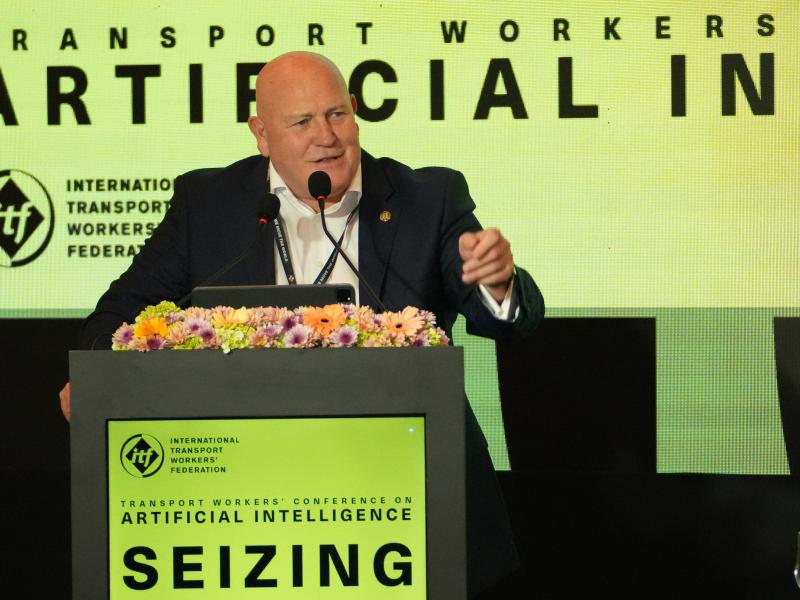
 ITF General Secretary Stephen Cotton speaks to media last year at a solidarity march for the sacked seafarers | (Credit: ITF)
Cotton said the lack of action from the UK government was even more appalling considering Hebblethwaite admitted to a British parliamentary hearing that he broke the law and said he would do so again.
P&O Ferries broke the law on 17 March 2022 when it fired the workers via a pre-recorded Zoom call, flouting the country’s requirement for employers to consult with employees’ unions, in this case the RMT and Nautilus International. Crew were then escorted off ships by security guards wearing balaclavas, and quickly replaced by overseas-sourced, non-unionised agency staff recruited on much lower pay.
Under the scheme, the new workers were paid less than the UK national minimum wage and were expected to work tours of duty so long as to be considered unsafe.
“When a company so blatantly breaks the law and then violates national minimum wage statutes, one would expect the British government to stand up for the rights of their own citizens and against lawbreaking multinationals,” said the General Secretary of the European Transport Workers’ Federation, Livia Spera.
“By allowing employers to treat its citizens’ legal and contractual protections as merely ‘optional’, the UK government is giving the green light to a race to the bottom in transport, in safety, in wages – and that drives down standards across the whole of Europe,” she said.
Global solidarity with sacked seafarers
“P&O Ferries are a disgrace to the European ferries sector,” ETF’s Spera said. “We took very seriously what happened with P&O, and that is why transport workers voted CEO Peter Hebblethwaite as the worst employer in Europe at our Congress last year.”
Since then, unions in the UK and globally have continued to hold the company and its leadership to account for their shameful treatment of workers.
In April, ITF’s Cotton delivered a petition with more than 10,000 signatures to P&O’s Dubai-based owner, DP World. Unions then mobilised in October to see Hebblethwaite unceremoniously dumped as a key speaker from the industry’s Interferry’s conference line-up.
Hebblethwaite would go on confirm P&O’s fall from grace by being crowned ‘Worst Boss in the World’ at the ITUC’s Congress in December.
Legal tools needed to stop corporate lawbreaking
Unions are demanding changes from Westminster to secure fairer ferries going forward.
Regionally, the UK government needs to secure bilateral agreements with nearby countries to ensure standards across key ferry routes and avoid a race to the bottom.
Closer to home, RMT and Nautilus have been pushing for amendments to the Seafarers’ Wages Bill. The government’s proposed law would force operators to pay the UK national minimum wage when their ferries are in UK territorial waters. But the law should also facilitate agreements between unions and operators on critical employment and safety conditions, such as caps on the length of time spent at sea.
Concerningly, even with amendment, the new law on its own would not be enough to stop a repeat of the illegal firings. For that, new legal tools are needed in the workplace.
“The law they’ve proposed wouldn’t have stopped P&O Ferries,” said ITF’s Cotton.
“In order to prevent another jobs massacre, the UK government must to scrap the ability of corporates to buy their way out of facing justice, as happened in this case.”
“The UK government needs to make it possible for workers and unions to enforce the rights we already have on paper, so that companies like P&O Ferries have no choice but to follow the law in practice,” he said.
Under the changes sought, unions would be able to apply for ‘injunctive relief’ from UK courts, who will be given new powers to suspend sackings from taking effect until proper procedures had been demonstrated to have been followed by employers. Workers’ could also be reinstated if they had in fact been wrongfully dismissed.
ETF’s Spera said all workers needed the legal and industrial tools to stand up for themselves and their rights when employers flouted the rules. “From our perspective, we can see it has become too easy for corporations to exploit workers not just in Britain, but across Europe, and too hard for workers to fight back.”
“Without a rebalance towards fairness, Britain risks further deepening the shortage of workers in transport, and the big or transnational corporations will not be the ones coming with the needed solutions”, she said.
ENDS
Both the National Union of Rail, Maritime and Transport Workers (RMT) and Nautilus International are affiliates of the ITF and ETF.
About the ITF: The International Transport Workers’ Federation (ITF) is a democratic, affiliate-led federation of transport workers’ unions recognised as the world’s leading transport authority. We fight passionately to improve working lives; connecting trade unions and workers’ networks from 147 countries to secure rights, equality and justice for their members. We are the voice of the almost-20 million women and men who move the world.
About The ETF: The European Transport Workers’ Federation (ETF) is a pan-European trade union organisation which embraces transport trade unions from the European Union, the European Economic Area and Central and Eastern European countries. The ETF represents more than 5 million transport workers from more than 200 transport unions across 40 European countries. These workers are found in all parts of the transport industry on land, at sea, and in the air.