Sustainable transport must be at the heart of every African country’s plan for economic development, according to a new report from the International Transport Workers’ Federation (ITF).
Europe, the US and east Asia – the regions historically responsible for the carbon emissions driving the climate crisis – must fulfil their pledge to finance Africa’s decarbonisation transition, the report says.
While African countries are amongst the worst hit by climate change, the continent accounts for a mere 3 percent of historic energy-related emissions and has the lowest emissions per capita of any region.
In April this year, record rainfall South Africa saw flooding and landslides devastating parts of its eastern coast. More than 400 lives were lost and over 12,000 homes destroyed, displacing an estimated 40,000 people. The Port of Durban, which accounts for around 60 percent of the country’s exports, and is a key gateway to sub-Saharan Africa, was severely impacted, along with critical roads and railway supply lines. This is just one instance of the destruction being causes by climate change in Africa.
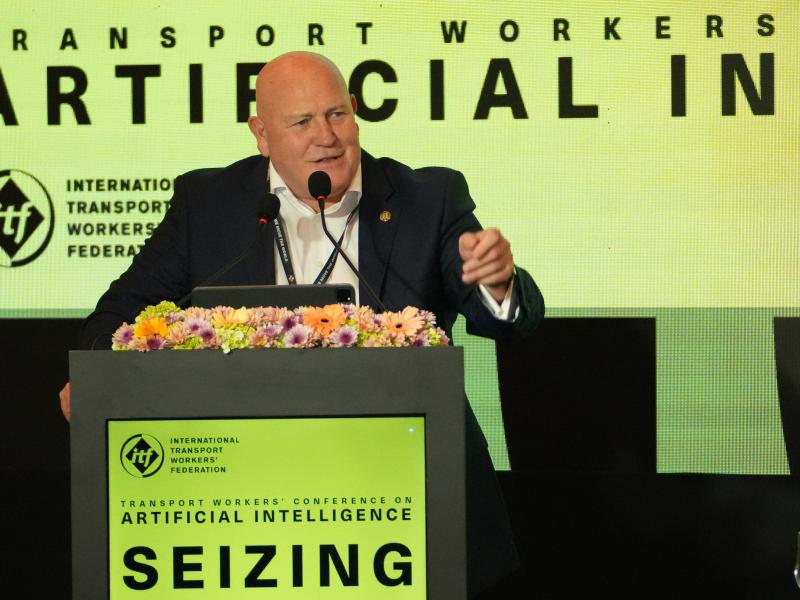
“The climate crisis is here,” said Stephen Cotton, General Secretary of the ITF. “The people of Africa are already experiencing soaring temperatures and devastating floods, sandstorms and droughts. Transport workers are among the most exposed to these escalating extremes, while transport emissions continue to rise globally, which will inevitably make Africa’s climate impacts even worse.”
“Transport is central to people’s lives and its development is closely associated with improving economic welfare. But as well as making sure that new transport systems do not add to the carbon problem, we must plan for a world where more frequent extreme weather is a fact of life. We must build in resilience now.”
Developed countries must meet finance promises
In 2009, developed nations promised to deliver USD $100 billion a year to assist developing nations in climate change mitigation and adaptation. To date, these governments have failed to fulfil this commitment. They must make up the shortfall in past payments, estimated to reach USD $75 billion by 2025, the report says.
“Finance is critical to Africa’s zero carbon development. Without urgent action from rich governments to honour their climate finance commitments to the Global South – to both expand transport systems sustainably and build resilience for critical transport infrastructure, efforts to halt this crisis will fail,” said John Mark Mwanika, ITF’s Urban Transport Chair and Programs Officer at the Amalgamated Transport and General Workers' Union (ATGWU-Uganda).
“The destruction caused by this crisis will be felt by people across the world. By not fulfilling climate finance commitments to support developing countries, rich countries are not just failing people in the Global South, they are failing the people who vote for them,” said Mwanika.
Urban growth
Africa is set to have the world’s fastest urban growth, with an additional 950 million people living in cities by 2050. Currently, informal transport systems are dominant in African cities, and produce high emissions, noise and air pollution, and have high accident rates. But these systems offer a vital service to urban populations in cities without formal urban transport.
“Access to clean, safe, frequent, affordable and accessible public transport is key to keeping emissions down as the continent urbanises,” said Mwanika. “We need to transition to formal transport systems across cities. Transport workers must be part of leading this formalisation where the regulation of routes and services is part of a managed transition from informal to formal transport networks.”
The report states that this will bring in cleaner vehicles, reduce emissions and improve road safety, whilst bolstering wages and conditions for transport workers – driving both sustainable development and generating decent employment. The report shows how a just transition can be achieved, ensuring that a move to lower carbon transport systems becomes an opportunity to create a better world for transport workers and the passengers that rely on their services.
Union-led work in the Philippines, for example, has seen the formation of driver cooperatives to manage and fund the replacement of minibuses with electric vehicles. In Africa, ITF unions are calling on governments to negotiate and integrate informal public transport services into new bus rapid transit (BRT) systems.
For their part, African countries must revise their climate action plans in consultation with workers to ensure that transport sector needs are fully set out, with required financing.
“But it is crucial that climate financing excludes forms of funding which effectively transfer the cost to African countries, contributing to debt distress and diverting resources which should be supporting economic and social development,” said Mwanika.
The ITF’s demands
- Governments and financiers must be more ambitious if we ware to meet the goal of limiting global warming to 1.5°C.
- We need urgent action to achieve climate resilient transport systems and working conditions fit for Africa’s current and projected climate realities.
- Solid industrial plans are needed for each transport sector. Worker expertise, participation and support is critical for such plans to succeed. We need a just transition for workers, with good jobs, conditions and social protections.
- The countries most responsible for the climate crisis must follow through on climate finance for Africa. They must make good on their commitment to USD $100 billion a year, with additional payments for past shortfalls, and engage in new finance targets based on Africa’s climate action needs. They must also agree a new and separate facility for loss and damage.