As states get green light to implement supply chain Directive, ETF and ITF demand more from landmark law
The European Transport Workers’ Federation (ETF) and the International Transport Workers’ Federation (ITF) are calling on European Union (EU) Member States to quickly introduce strong domestic supply chain due diligence laws to protect transport workers from corporate abuse.
The EU-wide Directive mandates companies with at least 1,000 employees and €450 million annual turnover to conduct of ‘human rights due diligence’ (HRDD). This means that about 5,500 EU and non-EU companies will have to identify, assess, prevent, mitigate and remedy adverse impacts in their operations and value chains.
Now that the legislation has been adopted by the European institutions, Member States have a two-year timeline under which they must implement their own domestic laws – with the Directive representing a minimum threshold.
The Directive is a significant breakthrough in achieving corporate accountability for human rights abuses in supply chains, with trade unions playing a key role in advocating for it.
At times during the four-year process, from its announcement to its approval, political stalemates threatened the Directive’s passage. It was significantly weakened under EU Member State lobbying, with the resulting Directive covering less than 0.05% of EU-based companies.
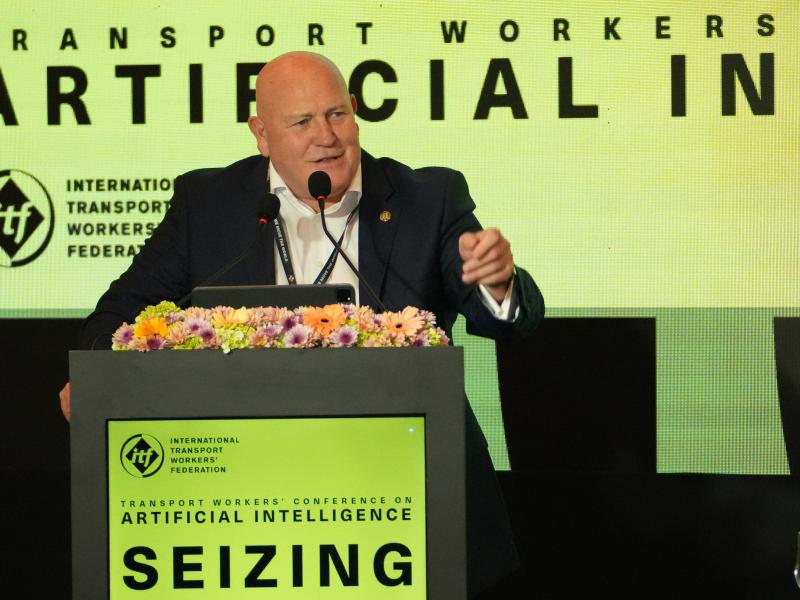
ITF General Secretary, Stephen Cotton, said: “This law is an important step in the struggle to prevent and secure accountability for corporate abuses of human and labour rights, and it sets a floor that states must go beyond if they’re serious about protecting our shared rights.
“But the weakening of the Directive from what was originally tabled served only to undermine the protection of our shared human and labour rights – and it now falls on EU states to step up and ensure they go further in their own laws.
“These countries have a duty to seize this huge opportunity to end corporate impunity once and for all.”
ETF General Secretary, Livia Spera, said: “The Due Diligence Directive is a very welcome and long-awaited first step. It is the first international legally binding instrument holding companies accountable for rights abuses in their global operations.
“Transport and logistics workers are key actors in global supply chains, keeping them functioning around the world.
“This Directive can help prevent multinational companies from misusing complex structures and subcontracting chains to circumvent human rights, social and environmental rules. At the same time, it can be helpful to companies using transport services to appoint only those companies that respect workers.
“But this is not the end. As the next step, we now want to see stronger domestic laws in force as soon as possible. We particularly want to see more companies covered by even stronger rules, alongside a more clearly outlined role for trade unions in monitoring and enforcing due diligence to protect transport workers.”
ENDS
ETF Media contact: Rodrigo Rivera +32 491 37 26 41 r.rivera@etf-europe.org
ITF Media contact: Mark Dearn +44 7738 832 413 media@itf.org.uk
Notes
- For more information on the Grafenhausen strikes, see here – ETF: Gräfenhausen strikers demonstrate that supply chain accountability is possible through workers’ solidarity.
- Trade union analysis of the European Commission’s original Directive is available here: A Missed Opportunity to Improve Workers' Rights in Global Supply Chains - Opinio Juris.
- Trade union analysis of the final Directive is available here: CSDDD – A timid step forward in the fight against corporate human rights abuse
- The ITF publication Respecting the human rights of seafarers in global supply chains is available here. Guidance for companies includes: an introductory meeting to set out worker-centred HRDD approaches in transport and logistics supply chains; a confidential ITF Rights Check to identify risks and human rights abuses of seafarers on ships carrying cargo; a dialogue with the ITF on risks and mitigation; an ITF cooperation agreement to work together to prevent and remedy human rights abuses.
- The ITF’s Supply Chain Principles are available here.
- More information on the ITF’s 2023 agreement with TFG Group is available here.