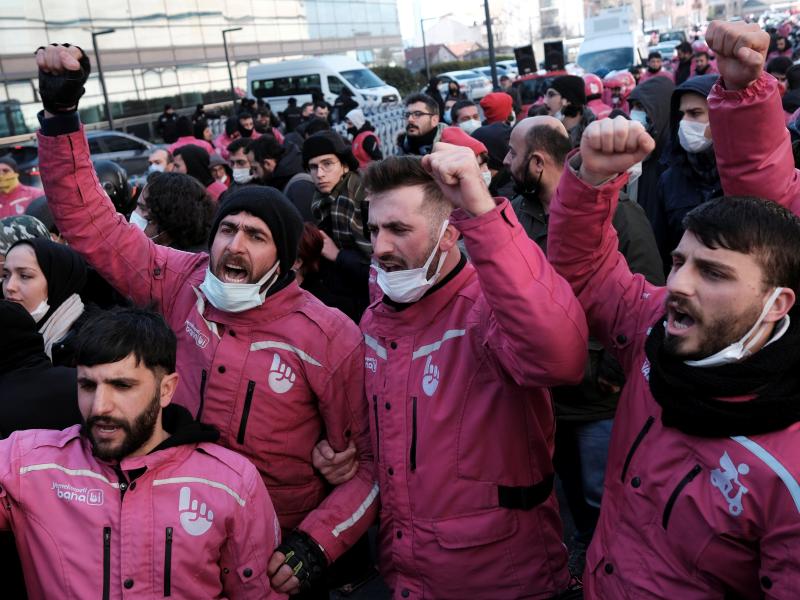
Global unions have taken legal action against the South Korean government for its extreme response to a truckers’ strike in the country, which ended on 9 December.
The South Korean Government invoked emergency laws as a justification to issue ‘return to work’ orders against individual drivers, which legal experts say are unconstitutional and in violation of international law. Government agencies have used investigatory powers to intimidate union leaders and threatened strikers with criminal penalties and financial claims for damages. These actions are all subject to a complaint filed by unions to the International Labour Organization (ILO).
“None of these actions are appropriate behaviour for a legitimate democratic government,” said Stephen Cotton, General Secretary of the International Transport Workers’ Federation (ITF). “Truck drivers in South Korea took the decision to strike only after the government reneged on an agreement to continue a sensible law which protects road safety and decent rates of pay. Unions have been very open to negotiating but the government is determined to brow-beat them into submission, denying them their basic rights in the process. This is quite simply unacceptable.”
Violating worker rights
A formal complaint against South Korea has been made to the ILO, covering government actions which violate principles of freedom of association guaranteed by the Constitution of the Republic of Korea and ILO Core Conventions 87 and 98.
The complaint has been made to the ILO’s Committee on Freedom of Association (CFA) by The Korean Public Service and Transport Workers’ Union (KPTU), the Korean Confederation of Trade Unions (KCTU), the ITF, Public Services International (PSI) and the International Trade Union Confederation (ITUC).
“The complaint outlines how the South Korean government is running roughshod over international law,” said Cotton. “The premeditated, systematic and unjustified anti-union actions of the Yoon Suk-yeol Government clearly violate workers’ most basic rights and the government’s obligations to uphold international labour standards. A modern democratic government should recognise that and live up to its responsibilities.”
In the complaint, the unions present clear evidence that the South Korean government planned to break the strike even before it started, and used the guise of a national emergency to justify its actions. The government treated an intervention by the ILO during the strike with contempt, the complaint says, and ignored obligations under international law.
Government representatives have slandered and criminalised striking workers, and encouraged companies to file claims for damages against workers and their union.
Strike ends, government onslaught continues
The strike began on 24 November. On 9 December, in the face of the government’s systematic suppression including the criminalisation of the strike and threat of criminal punishment for non-compliance with return to work orders, 62 percent of KPTU-TruckSol members voted to end the strike.
This vote followed an announcement by the opposition Democratic Party that they would pursue a three-year extension of the Safe Rates System to December 2025 the previous day. On 9 December a bill for the three-year extension passed the plenary meeting of the National Assembly Land, Infrastructure and Transport Committee with only opposition lawmakers present..
However, on the same day, the Minister of Land, Infrastructure and Transport Won Hee-ryong revealed his intention to maintain a hardline stance saying, “It is time to end the vicious cycle of indulging strikes without punishing them, as seen under the previous government”. Subsequently, the government and the ruling People Power Party have made clear they have no intention of cooperating with opposition lawmakers to pass the proposed legislation, saying their previous proposal for an extension was only valid before workers went on strike.
“It is intolerable that a government should use such heavy-handed tactics against a legitimate strike, but it is even more intolerable that the government is continuing to suppress the union and its members after the strike is over,” said Cotton. “The government is holding hostage a law that protects workers and saves lives on Korean roads.”
“It’s time that the government ended its authoritarian approach and engaged in good faith dialogue with TruckSol to keep its promise to workers and the public by continuing the Safe Rates system,” added Cotton.
KPTU-TruckSol has continued to protest in front of the National Assembly. On 12 December KPTU-TruckSol President Bongju Lee began a hunger strike calling for extension of the Safe Rates system.
“I hope this ILO complaint will bring about a change in the government’s attitude,” said Lee. “KPTU-TruckSol will not stop fighting to protect the lives of Korean citizens and workers on our road.”