Global markets are failing society and need to be fundamentally restructured, unions told the Pontifical Academy of Social Sciences at a meeting hosted by the Vatican on 9 and 10 August 2022.
The International Transport Workers' Federation (ITF) and a delegation of affiliated union leaders from around the world were invited to meet the Pope’s advisers to discuss issues impacting transport workers and the wider society. The delegation was supported by Pope Francis, who opened the Pontifical Academy of Social Sciences specifically for the meeting and greeted the entire delegation during the General Audience on Wednesday.
Both the Church and the unions agreed that business leaders must act urgently to pull the world back from the brink of recession. They should do this by recognising their obligations to the common good, and contribute to building a sustainable global economy. This should be based on social justice and the right to decent work.
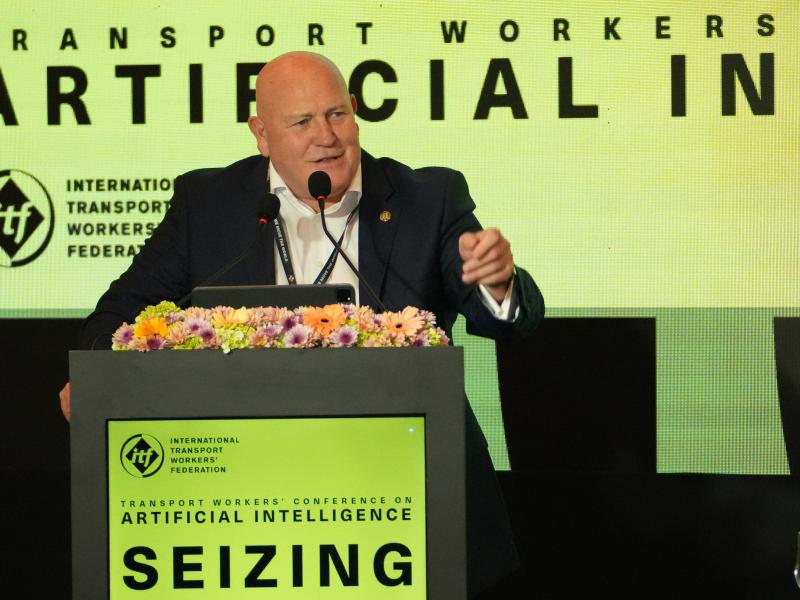
“Companies and governments must take responsibility for what is happening in supply chains,” ITF President Paddy Crumlin told the meeting. “Their blinkered approach amounts to corporate greed and ignores the greater good. The existing system promotes human suffering. That must end.”
Transport hijacked for profit
Transport systems are crucial to societies, Crumlin said, whether we are talking about buses that get people to work, or the vast shipping networks that underpin global commerce.
“Over the last few decades, these have increasingly been hijacked by capitalists motivated simply by profit, often to the detriment of the people who work in transport – and the people who rely on it,” said Crumlin.
The concentration of wealth and power in the hands of a few is increasing year by year – at the same time people are losing faith in democracy. Global GDP has trebled since 1980, yet labour income share has declined, and we have exploding levels of unemployment. Inequality is now widely recognised as a global risk.
“Energy companies, the Goliaths of e-commerce, and shipping giants are all making record profits,” said Crumlin. “The resources exist to fix problems facing workers today and working people from suffering. We must hold those in power to account for the decisions they make.”
The ITF is developing the infrastructure to become the world’s authority on supply chain accountability, Crumlin explained. Workers and their unions are at the forefront of re-designing the corporate model so that companies abusing workers’ rights come under the spotlight.
With a trillion dollars of deferred wages under union-managed pension funds, workers are in a unique position to influence stakeholders and encourage investors to move capital to where it can do most good, underpinned by environmental, social and governance principles.
Crisis upon crisis
Achieving progress on workers’ rights remains a struggle as humanity faces crisis after crisis, union leaders told the Pope’s advisers. However, this only redoubles the determination of working people and their representatives to see justice prevail.
The impact of climate change on transport workers, the lingering effects of the Covid-19 pandemic, the wars in South Sudan, Syria, Ukraine and Yemen, and the threat of world-wide recession were all discussed.
Climate change and the need for a just transition to zero-carbon transport systems were major points. Transport represents 25% of global energy-related greenhouse gas emissions, 15% of all emissions, and is the fasted growing sector for emissions – they are set to double by 2050.
“We are in a race against time to stabilise the planet and mitigate the impacts of climate change,” said Stephen Cotton, the ITF’s General Secretary. “But social and economic justice must go hand-in-hand with technological advances, so that we emerge with a better world for everyone and not just another crisis averted.”
The transport sector requires investment of USD $32 trillion by 2050 to decarbonise. In responding to this crisis, transport unions demand that workers have a say. We must ensure that we see a just transition to a carbon-neutral world, Cotton said, particularly in the Global South.
Progress for women has stalled
Cotton also pointed out that all parties need to re-energise work in building a gender-equal society. Women are still under-represented in the transport sector and are more likely to have the lowest-paid and most precarious jobs. A collective focus on this issue remains essential, he said.
Speaking on behalf of the Argentine transport workers’ union FNTCOTAC, its Vice President Pablo Moyano said that unions have a history of fighting for working people in times of crisis.
“The strength of solidarity among transport workers is a solid foundation on which to shape change,” he said, “whether on technology, climate justice, or in fighting human trafficking and corruption.”
Other union leaders addressed the need to champion democratic values, tackle corporate greed and support the role of young workers in driving change.
The wars around the world, and the suffering they cause, cast a shadow over the meeting. As a result of conflict, one person is forcibly displaced every three seconds, it was noted. The bravery and tenacity of transport workers who continue to risk their lives to get vital supplies into these countries must be applauded, the meeting agreed.
“If we don’t build a shared and sustainable future and protect and preserve the rights and opportunities for future generations, we fail to uphold our values,” said Crumlin. “Together with all of our allies, unions will organise for rights and social justice. We will act together in solidarity. We will leave no one behind.”