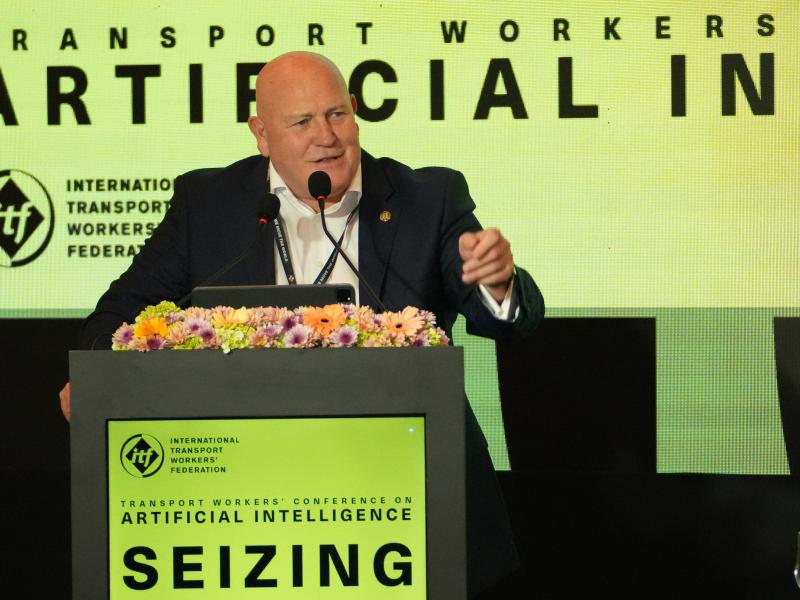
Twenty-one participants, including union general secretaries and project coordinators from Uganda, Kenya, Rwanda, Tanzania and Burundi, gathered to exchange ideas and develop action plans to enable them to engage with key players such as the labour and transport ministries in the EAC regional integration programme.
During the meeting – which was organised by the ITF in conjunction with FNV Mondiaal and officially opened by Uganda’s minister for labour and industrial relations, Kamanda Bataringaya – participants discussed several persistent problems road transport and informal sector workers face along the corridor. Topics included the lack of written employment contracts, well-staffed safety stops and professional driving schools. Other burning issues were the need for better working conditions, including medical and life insurance, and harmonised traffic and road safety legislation in East Africa, where some countries drive on the left and some on the right, in the same corridor, leading to fatal accidents.
The participants presented a memorandum containing their observations, suggestions and demands, to representatives from Uganda’s police service, road safety authorities, labour and transport ministries, as well as to the ministry in charge of EAC affairs.
At the end of the workshop participants committed themselves to strengthening and expanding their communication networks and developing communication action plans. They pledged to keep in constant contact with each order in order to promote practical cross-border solidarity.
In his closing speech, ITF Africa regional secretary Joe Katende said: “Transport workers move the economies of East and Central Africa through their activities in the corridors and hubs. However, despite the existence of clauses in the national constitutions of the EAC member states that guarantee labour rights, there are still numerous violations occasioned by lack of enforced labour standards. These manifest themselves in arbitrary dismissal of drivers who join unions, and the lack of basic facilities and services. These failings must be addressed.”