The International Transport Workers’ Federation (ITF) welcomes the recent Advisory Opinions from the International Court of Justice (ICJ) and the Inter-American Court of Human Rights (IACtHR), which reaffirm States’ binding legal obligations to tackle the climate crisis and protect human rights.
The ICJ’s finding that the right to a clean, healthy and sustainable environment is a precondition for all other human rights is a major step forward. Its conclusion that States must prepare meaningful, substantive Nationally Determined Contributions (NDCs) – and that failure to do so could amount to an internationally wrongful act – sends a strong signal on accountability. It also concluded that States are also bound by customary international law to prevent environmental harm – this includes robust due diligence standards. 1.5°C was confirmed as a binding legal obligation of all States Parties to the Paris Agreement. The Court also found that States can bring claims against each other to the ICJ for compensation.
Equally significant is the IACtHR’s recognition that the climate crisis directly threatens labour rights. It is the first international court to explicitly connect the climate emergency with protections for working people, and to acknowledge the vital role of unions in delivering a just transition. The Court cited the International Lawyers Assisting Workers Network’s (ILAW) legal brief, which highlighted how climate change disproportionately harms workers—especially agricultural workers, migrants, and those in the informal economy—and outlined the need for just transition policies rooted in consultation with unions.
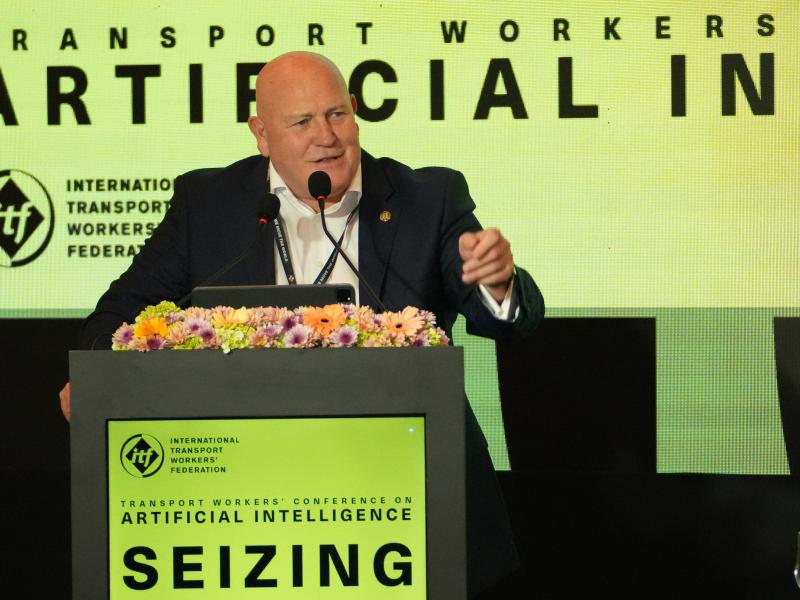
However, these decisions also expose a dangerous gap said ITF General Secretary Stephen Cotton.
“Transport workers are on the frontlines of the climate crisis – from heat-exposed delivery drivers and rail staff to seafarers and aviation workers navigating more volatile seas and turbulent skies,” said Cotton. “We cannot talk about climate justice without talking about labour justice. Yet too often, labour rights are an afterthought in climate policymaking.”
While the ICJ rightly drew on international human rights law, it failed to explicitly reference core labour rights: the right to work, to safe and healthy working conditions, to social protection, and to organise and bargain collectively. As set out in the ITUC and ITF legal brief to the Court, these rights are essential for delivering climate action that is fair, equitable and sustainable.
“The transition must be just – or it will fail,” said Cotton. “Governments have legal and moral obligations to include workers and unions at every stage of climate planning and delivery. That means embedding labour protections in NDCs and ensuring that no worker is left behind.”
The ITF, together with the ITUC and ILAW Network, has long advocated for climate policies grounded in labour rights and union consultation. We urge States to act on these authoritative Advisory Opinions by strengthening NDCs and ensuring they uphold the rights and dignity of all workers.