Unions are welcoming a decision from the EU maritime watchdog which avoids up to 50,000 Philippines-certified crew being barred from working aboard European-owned ships.
The European Maritime Safety Agency (EMSA) announced last week that it will continue to recognise STCW certificates (Standards of Training, Certification and Watchkeeping) issued by Philippines-based training providers after the country’s president made moves to address decades-long problems with his country's seafarer training systems.
The EU had for many years been concerned about both the quality and consistency of training, with some graduates equipped to handle modern ships and others requiring supplemental training from employers. As far back as 2006, EMSA identified deficiencies and continued to find problems in the 13 inspections it conducted since. The agency’s most recent audit, held last year, led to the country’s final warning.
ITF welcomes EMSA decision, optimistic on reforms
“We are relieved to see EMSA pulling back from the brink with this decision and avoiding the risk of losing 50,000 of the world’s finest maritime professionals from working aboard European vessels,” said Stephen Cotton, General Secretary of the International Transport Workers’ Federation (ITF).
“I am sure that is very welcome by the European shipowners just as it is by Filipino crew, their families and their unions,” he said.
Cotton said if EMSA had stopped recognising Filipino certificates, a ban would have sent economic shockwaves through the country’s economy. $6.54b USD in wages were sent home by Filipino crew working on international ships in 2019, alone.[1]
“There’s no doubt that Filipino seafarers are prized in the industry for their skill, expertise, and professionalism: there is good reason that they remain the world’s number one source of seafarers.”
“Sadly, the quality and certification systems Filipino crew need to be able to rely on, have been lacking for some time now,” said the General Secretary.
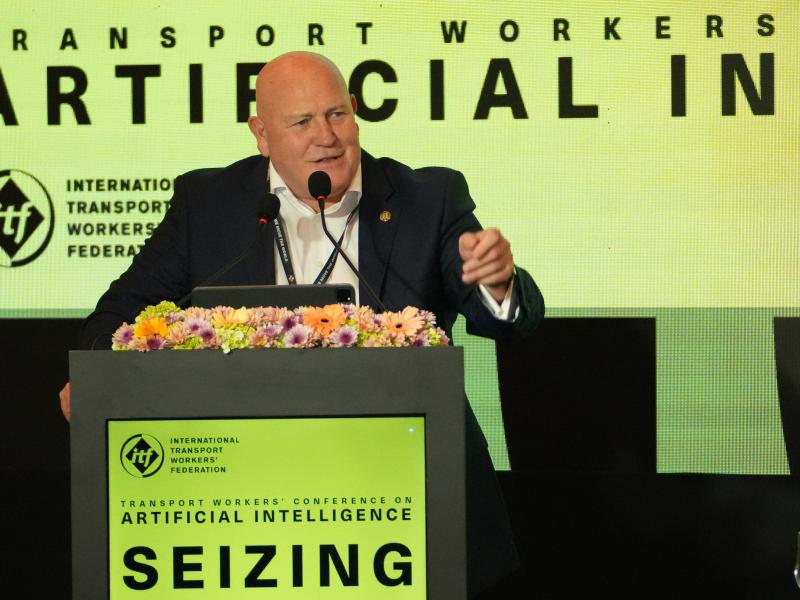
 ITF General Secretary Stephen Cotton welcomed EMSA’s decision to continue to recognise training certificates issued in the Philippines, preventing some 50,000 Filipino crew from being banned from crewing European ships. (Credit: ITF)
The ITF and its Philippines-based affiliates had been advocating for years for Manila to iron out the country’s inconsistent training outcomes, along with dumping underperforming providers who consistently untrained crew.
ITF advising Marcos govt on training upgrade
It is understood that decision-makers in Brussels were convinced by recent announcements by President Ferdinand Marcos Jr’s administration to finally address the country’s years-long issues in training.
Alongside more immediate measures, Marcos ordered in December the establishment of a high-powered advisory council made up maritime industry experts.
Representatives from the ITF, shipowners’ association ICS, and other industry bodies will form the new ‘International Advisory Committee on Global Maritime Affairs’ (IACGMA). While its first task is to advise on the training and certification reforms needed, the committee’s ability to work across a multitude of government ministries and agencies on thorny and complex maritime sector issues is a model unions and shipowner groups hope will unlock progress on climate and other pressing issues facing the country’s maritime sector.
Cotton said the Advisory Committee was just one example of the way the sector had shown the Philippines was now on the right path to delivering the improvements industry, crew and regulators had been asking for.
“I have every faith that we can get to a place where a Philippines certificate is synonymous with being first-rate and world-class. In many ways, Filipino crew already are,” he said.
Just Transition, apprenticeships overhaul
Barcellona said the ITF would be raising both the training and climate issues through the advisory committee with government figures, because the issues were closely connected.
“Training had never been more important for people working at sea,” said Fabrizio Barcellona, ITF Seafarers’ Section Coordinator. “Climate change is driving a need for 800,000 seafarers to be trained or retrained to handle new fuels and technologies by 2030.”
“Countries with the better training systems will be able to respond better to the changing needs of the global seafaring market. Their seafarers will be more attractive to the growing number of shipowners who are already buying billions of dollars’ worth of new, next-generation vessels.”
Barcellona said more crew needed to spend more time on board early in their careers, allowing them to become familiar with the rapidly changing technologies found in vessels nowadays.
That is why the ITF is suggesting a major upgrade to the country’s systems of apprenticeships and cadet training, for ratings and for officers, respectively. The federation wants to see the Philippines shifting from a model of disorganised apprenticeship and cadetship arrangements, which are cobbled together temporarily between individual employers and training providers, to a new, modern and coordinated model with quality, enduring schemes backed by shipowners, unions and government.
 ITF Seafarers’ Section Coordinator Fabrizio Barcellona (Credit: ITF)
A more structured, quality-assured system of bringing through officers and ratings would have benefits for the country, because shipowners, like those in Europe, could have greater confidence that Filipino crew were being equipped with the competencies required by modern vessels.
Exploitative ‘ambulance chasers’ in ITF’s sights
Just Transition and training were just a couple of the issues that are part of policy challenges that the Philippines’ government needed to tackle to improve employment and wellbeing for crew.
The ITF also planned to raise the need to overhaul the Philippines’ broken system of seafarer workplace compensation, which has overtime seen the rise of widespread predation of crew by so-called ‘ambulance chasing’ lawyers.
Employer fears about spurious legal actions have led many shipowners and ship managers from avoiding the recruitment of Filipino workers altogether.
“These ‘ambulance chasers’ – these lawyers, they do not always have seafarers’ best interests at heart,” explained Barcellona. “Many simply use crew as a pawn to get an out-of-court settlement from an employer for themselves.”
Barcellona said it was common for the lawyer or their firm to issue seafarers with ethically questionable loans at predatory interest rates, as crew waited for the settlement promised to them. In practice, the long wait means crew have to watch on as lawyers’ fees and mounting interest eats away at any pay out they had once expected to receive.
Clean-up of manning agents ‘overdue’
The ITF is also demanding changes to the Philippines’ system of governing crewing, or ‘manning’, agents. While many were working honestly and effectively on behalf of seafarers, there remained a not insignificant number of crewing agents which repeatedly fail crew.
All crew seeking work on international ships are required to use an agent to be placed on a vessel. Once onboard, they have to send the majority of their wages home via that agent (called ‘allotments’). Many agents charged crew unfair exchange rates when getting the allotments shoreside, effectively clipping the ticket twice on top of the fees they charge seafarers.
Agents are supposed to protect crew from irresponsible shipowners and potentially devastating outcomes from employer negligence, such as if an employer refuses to honour their obligations to pay crew. In that case, the agents are supposed to step in and cover the owed wages.
While the Philippines agent system is good on paper, giving effect to many of the Maritime Labour Convention’s principles intended to benefit workers in an uncertain industry, in practice the country’s poor enforcement of the rules meant many agents have been able to operate despite failing crew and breaking the law.
This situation had led the ITF to establish the ITFShipBeSure.org website dedicated to helping crew steer clear of the agents which seafarers’ unions consider the worst.
“These are all things which are central to the ITF agenda to support Filipino seafarers so that the Philippines can continue to be a maritime leader for decades to come,” he said.
ENDS
Notes:
Cover image credit: University of Asia and the Pacific
References:
[1] According to the central bank of the Republic of the Philippines Bangko Sentral ng Pilipinas (BSP), Filipino seafarers remitted over USD $6.53 billion in 2019 alone.