Dutch union federations have struck a deal with Schiphol Airport, Amsterdam, to boost pay in this frenetic post-Covid-19 summer, and improve conditions in the long term.
The agreement is a piece of history because it extends beyond those who work directly for the airport, to include people employed by subcontractors. It ends a long battle by unions to get airport managers to accept responsibility for the terms and levels of pay offered through outsourcing.
The International Transport Workers’ Federation (ITF) warmly welcomes the hard-fought deal between the Dutch union federations FNV (Federatie Nederlandse Vakbeweging) and CNV (Christelijk Nationaal Vakverbond), and Schiphol’s operators. A series of measures puts the welfare and well-being of workers ahead of cost-cutting. It is seen by both sides as an important step in combatting the staff shortages which have resulted in chaos at airports across Europe, as passengers flock back to air transport after the pandemic.
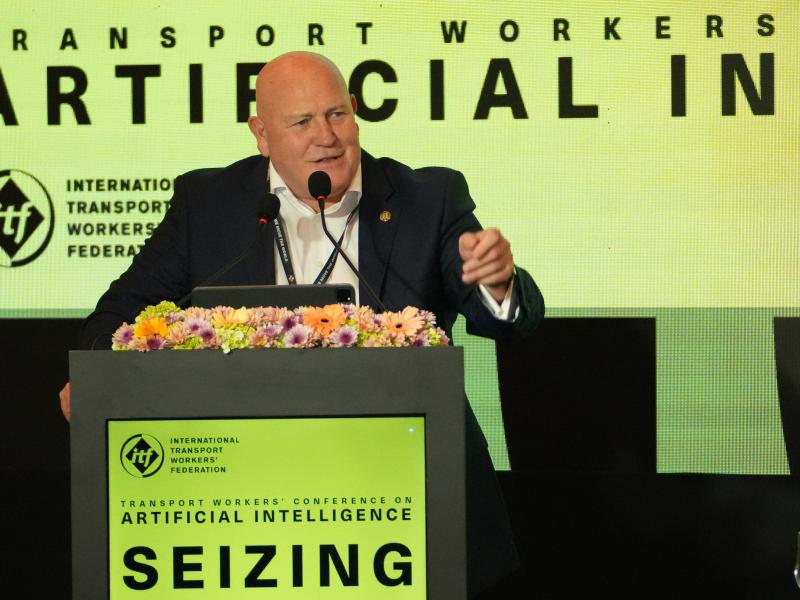
“Let’s make no bones about this,” said Stephen Cotton, the ITF’s General Secretary. “The current craziness is a direct result of cutting thousands of skilled aviation workers’ jobs during the Covid-19 pandemic, without any sort of planning for recovery. We have lost over two million workers from the industry. Now that passengers are returning to the air, the remaining workers are doing the jobs of two or three people.
“Poor decisions by airports, airlines and governments have seen travellers facing delays, last-minute cancellations and protracted waits to retrieve their luggage. This is something unions around the world warned would happen.”
Winning back airport workers
Now Schiphol hopes to retain and win back workers by imposing decent standards of pay and conditions on its subcontractors. The deal applies to all personnel working for companies at Schiphol through a tender agreement. This includes security personnel, bus drivers, cleaning staff, and passenger management services (such as check-in and baggage handling).
Workers will receive a bonus of €5.25 an hour during high season in 2022. (1 June — 5 September) plus a retrospective bonus covering the Dutch May holiday (23 April — 9 May). From September, they will also receive a bonus of €1.40 an hour until September next year.
The agreement will also see airport workers’ jobs being upgraded to a decent standard in the long term. Schiphol has agreed:
- Travel to work by public transport will be reimbursed, or free parking will be provided.
- That workers are guaranteed 10 continuous days of annual leave during the summer holidays.
- To creating a ‘social standard’ — working together with FNV — for working at the airport.
- That interns may not replace workers.
- To the introduction of equipment pooling in ground handling and a ‘License to Operate’ together with ground handlers, airlines and the FNV. It will also look towards reducing the number of ground-handler companies active at the airport.
- To investigate workload and passenger aggression on a regular basis.
- To grant unions access to workers and to create a new forum for social dialogue to give workers a stronger voice in the airport’s operation.
On health and safety, and social dialogue, unions used Toronto Pearson airport in Canada as an example of best practice, building on work by ITF affiliated unions there.
“I congratulate the FNV on achieving this landmark agreement,” said Cotton. “It is absolutely a template for other airports looking for ways out of the post-pandemic chaos we’re all experiencing. These workers are at the heart of aviation. Without them things simply don’t happen. Schiphol’s management has recognised the importance of decent work standards in getting operations to run smoothly. It’s time for other airports to step up and do the same.”
In the deal, Schiphol has committed to 11 basic principles:
- Health and safety are top priority.
- Working conditions and renumeration need to be adjusted to allow for the intensity of working at an airport.
- Workers should not have to pay to get to work or park.
- Permanent contracts are the norm. Temp work is only meant for covering peak periods and staff illness.
- Compliance to collective labour agreements and labour law will be investigated and enforced by Schiphol.
- Basic worker facilities such as break rooms and free coffee, tea and water will be provided.
- Personal protective equipment (PPE) and working materials will be provided free of charge at all times.
- Interns are meant to be learning on the job – they are not low-cost workers.
- Tenders (outsourcing) may not result in a decline of working conditions.
- Schiphol takes responsibility for working conditions and ensure that subcontractors comply.
- Schiphol will start hotline/information point where workers can notify the airport about shortcomings or safety issues.