A consortium of tech companies has reportedly gained sufficient signatures to have a law put on the Massachusetts’ ballot that would allow them to exploit workers - disproportionately black, brown, and immigrant workers.
Platform companies Uber, Lyft, DoorDash and Instacart, who make up the consortium, designate their workers as independent contractors, which allows them to avoid paying workers fairly, and dodge employment protection laws, among other things. In many places, including Massachusetts, the practice seemingly contravenes workers’ rights laws. Now the firms seek to exploit democratic processes to bully States into overturning those labour laws.
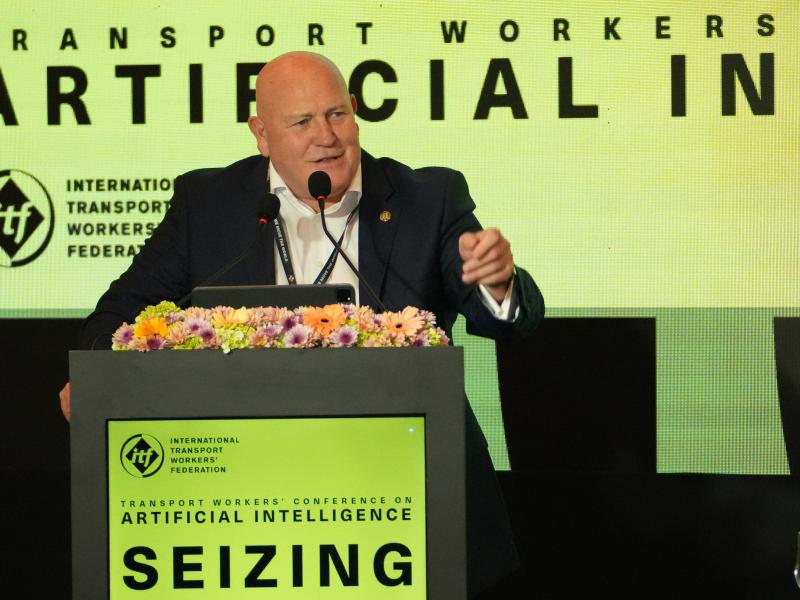
Stephen Cotton, General Secretary of the International Transport Workers’ Federation (ITF) said: “These companies are paying out hundreds of millions of dollars to promote ballot initiatives that make a mockery of representative democracy, and which effectively make their own businesses unsustainable. Workers are getting wise to the myth that they get more flexibility in exchange for fewer rights and workplace protections. When they realise how bad the jobs are, they go elsewhere.”
“We’re already seeing the logistics and trucking industries in serious trouble because of decent work shortages which is in part driven by unfair gig-economy practices driving down conditions of employment. Big tech would do much better spending its money on giving workers a fair deal and creating businesses their customers can respect. We invite platform companies to work directly with the ITF and our affiliates to build a sustainable business model based on decent work for all.”
The ITF supports workers and advocates, unions, civil rights organisations, and other public interest groups in Massachusetts who have come together to fight against big tech companies’ attempts to undermine workers’ rights and benefits.
“We oppose carve-outs from labour laws for app-based workers and ask the people of Massachusetts to vote ‘NO’ when the measure appears on the ballot next November,” said Cotton.
Rules in some US States allow citizens to propose their own laws, in the interests of democracy. In Massachusetts, subject to approval of the State’s Attorney General and sufficient supporting signatures, anyone can suggest a law. That law will then be put to the people as a ballot, or referendum. If the people vote in favour, the bill goes the State legislature, before it may be enacted into law.
“The ballot initiative process was never intended to give big business a stick with which to beat down workers,” said Cotton. A similar law in California has been declared unconstitutional by the courts.
What happened in California should stay in California
Tech companies first tried this legal attack in California. The state’s AB5 law made it illegal to misclassify employees as contractors and thereby limit their wages and rights. The tech companies introduced Proposition 22 as a ballot to repeal this labour law and campaigned vigorously for the people of California to vote ‘yes’. They spent more than US$200 million to force the law through.
In November last year, the Prop 22 came into force but was challenged in the courts. In August 2021, the Alameda Superior Court in California declared Prop 22 unconstitutional, but tech companies are appealing. While the legal fight goes on, the tech companies are continuing to misclassify employees as contractors and pay them below minimum wage.
Now, they are starting the same process in Massachusetts, spending hundreds of millions of dollars more to push their exploitative business model on workers in the State.
The tech companies have cleared the first two hurdles. They have gained approval from the Massachusetts Attorney General despite the California court ruling. And they’ve achieved sufficient signatures for the ballot to be put to the people in November next year.
A recent study by the University of California Berkeley Labor Center revealed that if the big-tech ballot were to be implemented as law in Massachusetts, it would result in wages for app-based workers of just US$4.82 an hour. This is not enough to survive on in the state. Massachusetts has a minimum wage of US$13.50 for untipped employees, due to rise to US$15 by 2023.
The tech companies are claiming they pay US$18 an hour. The discrepancy is created because, by treating workers as contractors, they avoid paying for waiting times, and for some or all expenses including personal protective equipment.
“It’s outrageous that these app companies seek to pay workers only around a third of minimum wage,” said Cotton. “That’s bad enough. Now they’re trying to use the law to perpetuate workers’ suffering,” said Cotton.
“Now the people of Massachusetts must vote ‘NO’ to this attack on their working rights,” said Cotton. “Despite the huge amount of money the tech firms are likely to throw at this vote, our message is clear: the workers united will never be defeated.”
The ITF has 10 gig economy employer principles designed to give workers a fair deal. These demand an end to misclassification, as well as specific demands on social protections for gig workers related to living wages, safety, algorithmic management and data security.
More on the Massachusetts ballot
The Massachusetts App-Based Drivers as Contractors and Labor Polities Initiative (2022) will be voted on November 8, 2022, by all citizens in Massachusetts.
Some of the most troubling aspects of the Big Tech ballot language include:
- Extensive loopholes create a sub-minimum wage for app-based workers far from what big tech falsely promises. Labour economists found that nearly identical Uber ballot measure in California guaranteed just $5.64 per hour after loopholes.
- Removes antidiscrimination protections for app-based workers. Ballot measure exempts big tech companies from the robust protections of Massachusetts Civil Rights Act, MGL c. 151B, and removes state agency enforcement for app-based workers.
- Less than 10% of app-based workers would qualify for the healthcare stipend. For the few workers that qualify, the benefit is about $68 per month, less than 20% of the cost of a Bronze level family plan.
- Ballot eliminates 113-year-old Workers’ Compensation rules for big tech backers. Injured drivers and delivery workers denied protections in the fine print.
- Companies can continue arbitrary, unfair, discriminatory deactivations with no process outlined for earning reinstatement.
- Allows companies to cheat state unemployment system of hundreds of millions. While New Jersey seeks to recoup millions from gig giants, ballot measure allow gig giants to free-ride on a system paid for by law-abiding Massachusetts businesses.
- No Social Security contributions from big tech. Gig giants seek special exemption from paying into Social Security which denies workers basic dignity in retirement.
- Perpetuates “false choice” on flexibility. While big tech expands flexibility for favoured, high-status employees, the ballot measure falsely claims that drivers can only maintain scheduling flexibility by surrendering all other worker rights.