The announcement comes after an ILO meeting agreed proposals submitted by the IRU, representing taxi, bus, coach and truck companies worldwide, and the International Transport Workers’ Federation (ITF), representing transport workers’ trade unions across the globe. The decisions were taken at a meeting which closed at 13:30 today and brought together governments, employers and workers’ representatives to examine health and safety in passenger and freight road transport (see http://goo.gl/RHyPtQ). Its recommendations now pass to the ILO governing body.
The resolution on transport network companies (TNCs) backs the use of new technology that complies with laws and regulations and stresses the need for all providers to work from a ‘level playing field’ under which safety and working conditions are regulated for the good of all. It also acknowledges the need for decisions taken by competent authorities or the judiciary in relation to ride-sharing-for-reward transport platforms to be enforced.
The other resolution promotes road safety and calls on the ILO to: research good practice in the area, including the Safe Rates model (http://saferates.org.au) and develop a good practice handbook. It goes on to urge that the ILO convene a meeting of experts to adopt a code of practice or guidelines on road transport safety that aims to protect the community and road transport workers from health and safety hazards, preventing accidents and promoting safe and fair remuneration.
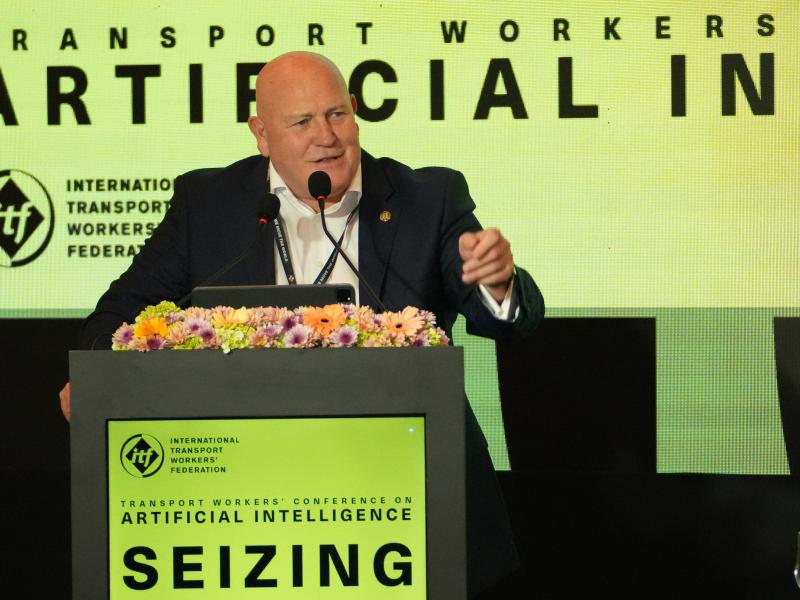
Speaking from the meeting, Tony Sheldon, ITF road transport workers’ section chair and national secretary of Australia’s TWU (Transport Workers’ Union) commented: “These are landmark decisions. One takes a major step forward in promoting road safety and carries the lessons learnt in an Australian campaign (see http://goo.gl/xpcKDG) to a world stage. Significantly, it connects safety and remuneration – and, crucially, accountability – right through the supply chain. Unsafe practices are deadly for road transport workers and everyone in the community who share the road with them. In Australia, the EU and US, work-related crashes are estimated to cause from about one quarter to over one third of all work-related deaths, according to the meeting report for discussion. In 2008, across just 10 countries covering the continents of the world, 327,479 people in transport, storage and communications were injured and 2,034 fatally injured.
“The other resolution is important to embrace the advantages of emerging transport technologies, while ensuring that they serve the wider interests and transportation needs of society. Regulations around road transport have been crafted to protect and serve citizens and must be upheld. All operators must respect them and operate within a framework of fair competition.”
Jens Hügel, IRU head of sustainable development, said: "The road transport sector embraces new technologies and innovation. Today’s resolution on TNCs highlights that all transport companies need to comply with the relevant laws and regulations. This is crucial for ultimately ensuring the security and wellbeing of passengers and drivers alike.”
ENDS
For more details please contact:
• Sam Dawson, ITF press and editorial manager, + 44 (0)20 7940 9260, dawson_sam@itf.org.uk
• John Kidd, IRU Head of Communications, +41 22 918 27 07, press@iru.org
The International Transport Workers’ Federation (ITF) is a global federation representing some 700 transport trade unions in 150 countries and their over 4.5 million members.
IRU is the world’s road transport organisation, bringing together bus, coach, taxi and truck operators to bring economic growth and prosperity through the sustainable mobility of people and goods. Founded in 1948, IRU works in more than 100 countries.