A delegation from the International Transport Workers’ Federation (ITF) is on the ground in Montreal, Canada, at the 42nd International Civil Aviation Organization (ICAO) Assembly.
The Assembly – which takes place every three years – brings together all 193 ICAO Member States from 23 September to 3 October 2025. Across two weeks of discussions, ICAO – the United Nations specialized agency that governs civil aviation – will adopt resolutions and set an agenda that will shape the future of global aviation industry.
This year’s event opened with ICAO Secretary General Juan Carlos Salazar stressing the importance of the Assembly as a turning point:
“This year’s Assembly serves as a crucial moment to shape the state of global aviation and drive real change for the benefit of all nations and people. ICAO is uniting the global aviation community around a shared commitment to a safe, secure and sustainable global aviation system that connects the world.”
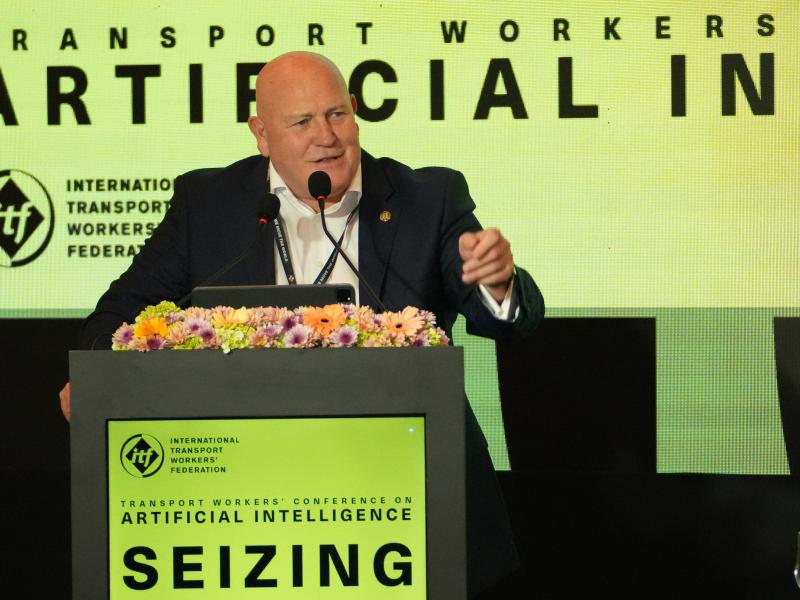
Welcoming this ambition, ITF General Secretary Stephen Cotton said:
“Real change in aviation cannot happen without putting workers at the centre. Millions of aviation workers keep this industry moving every single day – on the ground and in the sky. A truly safe, sustainable and connected global aviation system must be socially, environmentally and economically sustainable for the people who make it possible.”
Workers’ agenda for a sustainable aviation future
Together with sister federations – the International Federation of Air Line Pilots’ Associations (IFALPA) and the International Federation of Air Traffic Controllers’ Associations (IFATCA) – the ITF has submitted a package of Working Papers and Information Papers to the Assembly. These set out a clear path for reform, strengthening safety, and embedding social sustainability into the work going-forward on international aviation policy. All were presented on Thursday 25 September and Saturday 27 September.
Across the board, the Working Papers received broad support from the Assembly, demonstrating a growing recognition among Member States that workers’ voices and priorities must shape the future of aviation.
The agenda comes at a crucial moment. The industry is grappling with technological transformation – from automation and Extended Minimum-Crew Operations to the rise of drones – while simultaneously facing pressure to deliver on ICAO’s ambitious environmental and safety targets. For workers, these shifts bring both risks and opportunities – but they must not come at the expense of decent work, strong labour standards, or safe operations.
The ITF and IFALPA also had to respond quickly when IATA unexpectedly tabled WP/349, calling for an increase in the pilot age limit to 67. Together, we prepared and delivered a clear position: ICAO has already reviewed this matter in recent years, the scientific evidence remains inconclusive, and ICAO’s limited resources would be better spent on improving safety standards in more meaningful ways. The intervention was successful, with a number of states voicing opposition reflecting our arguments.
ITF’s spokesperson for the Assembly, Gabriel Mocho Rodriguez said:
“Our agenda at the Assembly, our Working Papers, come directly from the daily reality of aviation workers. Fatigue in the cockpit, cabin or control tower, fear of reporting safety concerns, or barriers to mental health support are not just workplace issues, they are threats to the safety of passengers and crew alike. By adopting workers’ reforms, governments can send a clear signal that the safety, dignity and wellbeing of workers are inseparable from the safety of aviation itself.”
“We are here to build relationships and alliances, and over the course of the Assembly we will be working directly with governments, regulators and industry partners to secure their backing for these reforms. If ICAO Member States take these proposals seriously, they will be strengthening not just aviation safety, but the resilience and sustainability of the industry as a whole.”
ITF and partners’ Working Papers
Summaries of the ITF and partners’ Working Papers are below.
- Social sustainability in civil aviation to enhance safety and enable the success of ICAO’s economic development agenda (WP/205) – Presented with Austria, IFALPA and IFATCA, this paper reaffirms that aviation can only grow on a foundation of decent work. It calls on ICAO to deepen collaboration with the International Labour Organization (ILO), embed social sustainability in its economic agenda, and ensure that workers are not left behind.
- Fatigue management (WP/258) – Co-sponsored by multiple states and industry groups, this paper recognises fatigue as one of the most persistent threats to safety. It urges ICAO to update its fatigue management guidance, strengthen oversight, and ensure proper resources are available so that regulators, service providers and frontline workers can effectively manage fatigue risks.
- Positive safety culture (WP/259) – This paper stresses that safety must be rooted in a culture where workers can report risks and errors without fear of punishment. It calls on ICAO to develop global guidance to harmonise how positive safety culture is defined, implemented and assessed, ensuring trust between workers, regulators and employers.
- Promote the development of peer support programmes in aviation (WP/334) – Addressing mental health and wellbeing, this paper calls for the development of confidential peer support systems across aviation. These programmes encourage early help-seeking, reduce stigma, and strengthen safety by ensuring professionals in safety-sensitive roles can access the support they need.
- Crew identification and the framework provided by Annex 9 (WP/285) – With IFALPA, IATA and TIACA, ITF is urging ICAO to modernize outdated provisions on Crew Member Certificates (CMC). The paper highlights the need to align ICAO rules with real-world practices and technological advances, including digital credentials, to ensure crew can move safely and efficiently across borders.