As governments around the world kickstart their Covid recovery plans, research launched today by the International Transport Workers’ Federation (ITF) argues that it is a pivotal moment for governments to inject long-term funding into public transport systems.
The global report says that emergency funding must tackle the immediate funding shortfalls confronting public transport agencies in many cities globally, and critically that governments must invest in the long-term interests of their citizens post Covid-19 including accelerating climate action.
Collapsing ridership and fare income due to Covid lockdowns has left public transport systems in many countries and cities on their knees. Recovery from the coronavirus pandemic is reliant maintaining the public transport services that move people through our cities, particularly to allow key workers and low-income users to travel.
People need public transport — it’s as simple as that. Public transport systems are the arteries of local economies,” said the report’s author Wol-san Liem, ITF Vice-Chair for Urban Transport, speaking today at the launch event for the report. “But in many places, they are on life support while governments dither about budget cuts and how to keep them going. Sustainable funding will give workers and our communities the security that is essential for recovery from the pandemic.”
The ITF’s report – The Pandemic, Local Public Transport Funding and Union Responses – takes a detailed look at the financial impact of the pandemic, and response measures in different parts of the world. Although the financial and policy environment varies dramatically from the global North to South, and for difference local and national jurisdictions, the report’s recommendations for recovery will assist policymakers wherever they are based.
“We have a plan to save our public transport systems while tackling climate change,” said Liem. “It puts public investment at the heart of the recovery, with worker participation, and a fair transition from Covid-19 emergency funding where it exists. As we approach the UN Climate Change Conference (COP26) in November, we will be working with our affiliated unions, civil society allies, local and national governments and public transport employers to put that plan into action.”
The elements of the plan
The report makes recommendations for policymakers worldwide, including:
- The report recommends that emergency funding is continued where it exists for all modes of public transport to ensure continuity of services and the protection of jobs and labour standards. This will also allow passengers to regain confidence in public transport as the threat of the pandemic recedes.
- For many countries, predominately in the global South, debt levels are a major constraint on investment in public transport. Cancelling those debts (made mandatory for private as well as official creditors) is the only way to ease that constraint and allow public transport to recover.
- The focus of development funding should shift to public investment in line with the global unions’ recent statement to the International Monetary Fund and World Bank Spring Meeting. Where development funding is used, measures should be put in place to safeguard social needs and protect the environment.
- We should be developing funding models for public transport that take a long-term and sustainable approach. These should include funding sources that redistribute, incorporate progressive fare structures, guarantee union participation in determining fair contract costs and subsidies, and achieve greater equality in pay and working conditions.
- We need to protect transport services for low-income passengers and people in precarious jobs. Public transport systems may need to be restructured to achieve this. Informal services and employment will need to be made formal and failing private services will need to go back into public ownership. Workers’ participation must be central to decarbonization and transition programmes.
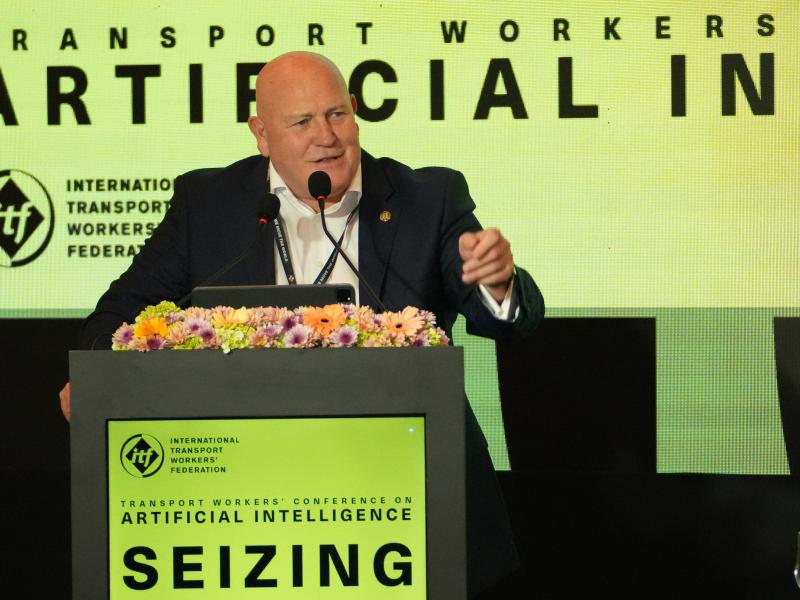
The report was launched today at a virtual ITF event, opened by ITF General Secretary Stephen Cotton and C40 Cities Executive Director Mark Watts. Many union representatives have already responded in support of the report’s recommendations, as well as civil society organisations from the Philippines, South Korea and Germany.
The recommendations add further weight to the The Future is Public Transport initiative jointly launched by ITF and C40 earlier this year to demand reinvestment in and modal shift to public transport services worldwide.
ENDS
Media contact: media@itf.org.uk | +44 20 7940 9282
Notes for editors: The Pandemic, Local Public Transport Funding and Union Responses is a supplementary report to the public financing chapter of the ITF’s People’s Public Transport Policy. The Policy provides a comprehensive vision for a social model of public transport, based on public ownership, decent work, gender equality and climate justice.
About the ITF: The International Transport Workers’ Federation (ITF) is a democratic, affiliate-led federation recognised as the world’s leading transport authority. We fight passionately to improve working lives; connecting trade unions from 147 countries to secure rights, equality and justice for their members. We are the voice for nearly 20 million working women and men in the transport industry across the world.