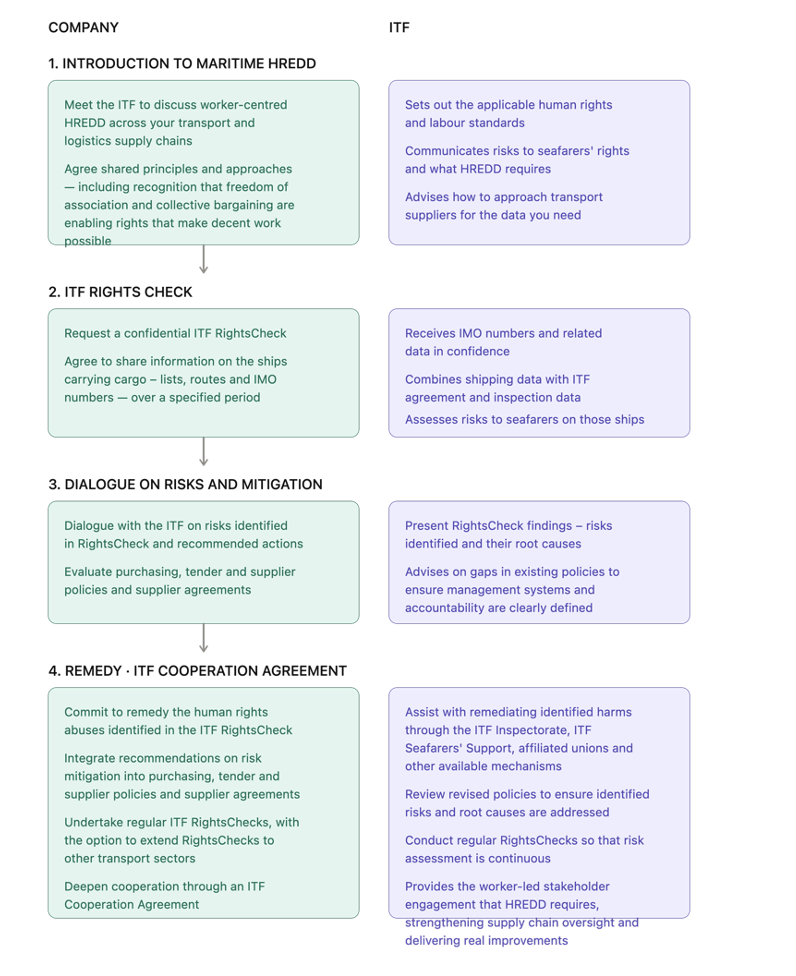
Working with the ITF on HREDD in maritime shipping follows four stages, each building on the last. It begins with establishing what standards apply and which ships actually carry your goods, moves to an evidence-based assessment of the risks aboard them, opens a structured dialogue on what those risks reveal about your own purchasing and contracting practices; and ends with remedy where harm is found, and continuous monitoring so that the process does not stop at a single snapshot.
Company
Meet the ITF to discuss worker-centred HREDD across your maritime shipping supply chains Agree shared principles and approaches — including recognition that freedom of association and collective bargaining are enabling rights that make decent work possible
ITF
Sets out the applicable human rights and labour standards Communicates the risks to seafarers' rights and what HREDD requires Advises how to approach transport suppliers for the data you need
Company
Request a confidential ITF RightsCheck Agree to share information on the ships carrying cargo – lists, routes and IMO numbers — over a specified period
ITF
Receives ship-specific IMO registration numbers and related data in confidence Combines shipping data with ITF agreement and inspection data Assesses the human rights risks to seafarers on those vessels
Company
Dialogue with the ITF on risks identified in RightsCheck and recommended actions Evaluate purchasing, tender and supplier policies and supplier agreements
ITF
Present RightsCheck findings – risks identified and their root causes Advises on gaps in existing policies to ensure management systems and accountability are clearly defined
Company
Commitment to provide or cooperate in remediation of human rights abuses identified in the ITF RightsCheck Integrate recommendations on risk mitigation into purchasing, tender and supplier policies and supplier agreements Undertake regular ITF RightsChecks, with the option to extend them to other transport sectors Deepen cooperation through an ITF Cooperation Agreement
ITF
Assist with remediating identified harms through the ITF Inspectorate, ITF Seafarers’ Support, affiliated unions and other available mechanisms Review revised policies to ensure identified risks and root causes are addressed Conduct regular RightsChecks so that risk assessment is continuous Provides the worker-led stakeholder engagement that HREDD requires, strengthening supply chain oversight and delivering real improvements