

Addressing human rights risks in warehousing and logistics requires HREDD that meaningfully involves warehouse workers and their trade unions in identifying, preventing and mitigating harm, and in delivering remedy.
The ITF Warehousing Principles set a floor for labour standards in warehousing globally. They draw together international and national regulation, the policies of leading warehousing and logistics companies, and guidance from industry experts and academics, across eight areas: fundamental principles and rights at work; safe jobs; secure and decent jobs; harassment and violence; the use of technology; a just transition; freedom of association and collective bargaining; and effective grievance mechanisms.
Companies will inevitably face risks that are not covered by practical steps for their prevention, mitigation or remediation in these principles, including some of the risks in this guidance – isolation and lone working and ergonomic and design-related risks. While the ITF can recommend generic approaches for addressing these risks – lone worker safety policies, ergonomic risk assessments, labour standards in procurement contracts – appropriate advice can be provided by working directly with the ITF.
As HREDD is inherently context-specific, advice on prevention, mitigation and remediation is often insufficient for dealing with specific risks in specific modes of transport. Transport buyers and suppliers seeking to identify and address human rights risks in warehousing should get in touch with the ITF for support throughout the HREDD process, from embedding responsible business conduct into policies and management systems, right through to providing for or cooperating in remediation, when appropriate.
WHAT EFFECTIVE HREDD REQUIRES IN WAREHOUSING AND LOGISTICS
Companies must address the commercial terms that create the risks. Fulfilment deadlines, cost-per-unit expectations and contractual terms determine staffing levels, work pace and productivity targets on the floor, so effective HREDD must assesses companies own procurement practices.
Obligations must extend to all workers – whether directly employed, agency-supplied or engaged through a further subcontractor. That means mapping subcontracting chains, limiting the number of tiers, requiring equal pay and conditions for agency and directly employed workers doing the same job, and holding logistics providers contractually responsible for standards across their subcontractors. It also means covering recruitment, where forced labour in warehousing and logistics often begins.
Companies must adopt clear commitments to neutrality and non-retaliation on trade union activity, support collective bargaining and worker representation in supplier facilities, and ensure ITF-affiliated unions can reach the workers handling their goods. And where harm is found it must be put right in cooperation with workers and their representatives.
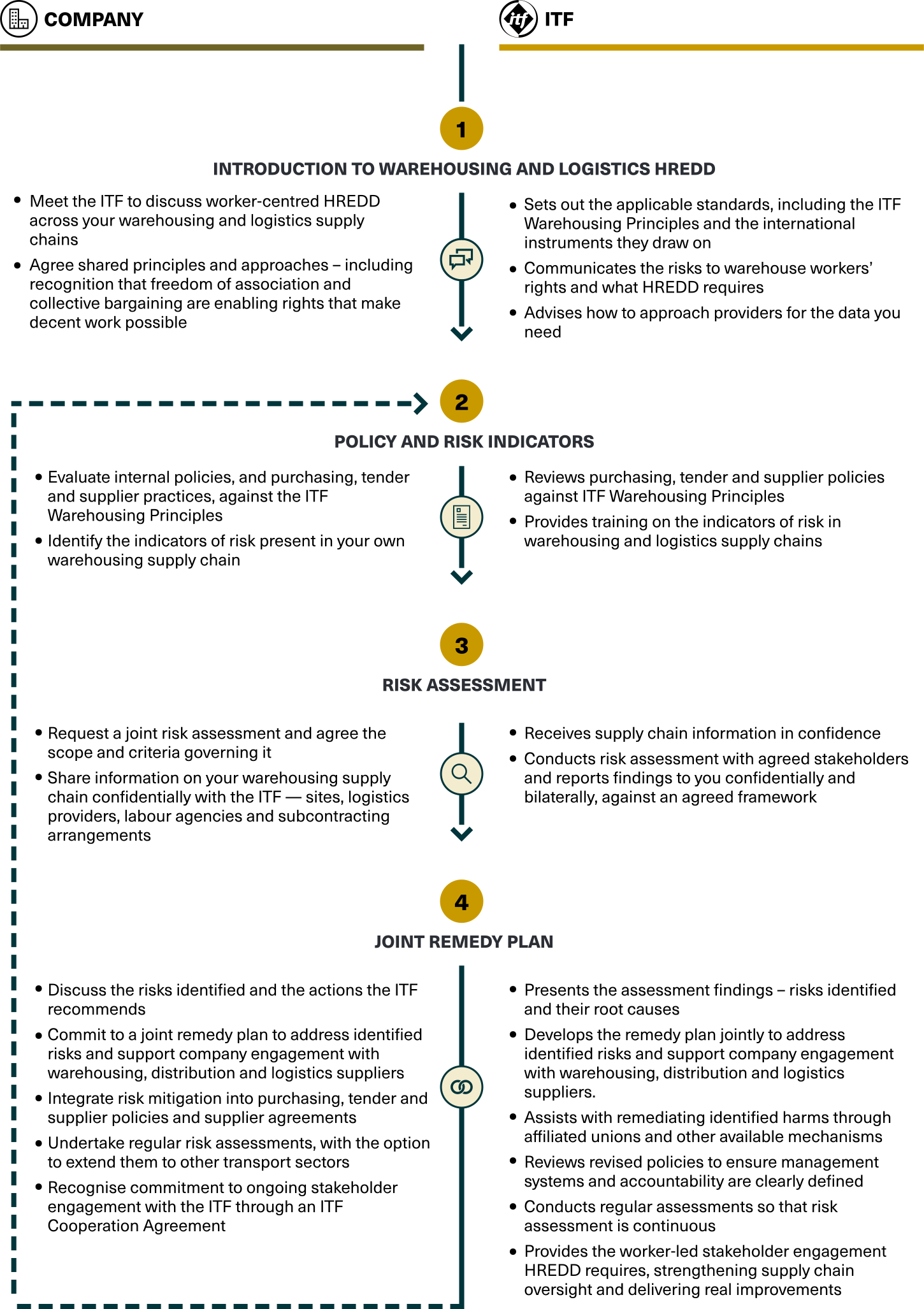
Working with the ITF on HREDD in warehousing and logistics follows four stages. It begins with establishing what standards apply and where a company's own commercial terms create risk, moves to a joint assessment conducted with the workers affected, opens a dialogue on the root causes those findings expose, and ends with a joint remedy plan and continuous monitoring, so the process does not stop at a single snapshot.