

The ITF can work with companies to establish clear, context-specific labour standards across fisheries supply chains – covering recruitment, wages, working time, accommodation, occupational safety and health, sanitation, freedom of association and protection from forced labour – and to embed them in procurement, contracting and supplier-management systems.
Working with the ITF and our affiliated unions gives companies access to trusted worker-led HREDD, established industrial relations mechanisms and credible processes for addressing human and labour rights risks – strengthening compliance with international standards and HREDD requirements.
Only fishers know what happens aboard the vessels catching your seafood. Effective HREDD in fisheries depends on hearing from them and on their trade unions providing direct insight into conditions on board, recruitment practices, wage systems, safety risks and barriers to worker representation – enabling companies to identify harms that audits and conventional compliance processes do not reach.
The ITF and affiliated fishers' unions can also strengthen responsible recruitment and employment practices, particularly for migrant fishers, aligning recruitment systems with the ILO Recruitment and Placement of Migrant Fishers Guidelines. And at the vessel level, companies can work with the ITF to develop vessel-specific codes of conduct on labour rights, OSH, violence and harassment, non-discrimination, grievance procedures and freedom of association – developed with worker participation, communicated to all crew, and backed by monitoring and enforcement.
WHAT EFFECTIVE HREDD REQUIRES IN FISHERIES HREDD
must begin at recruitment. Recruitment fees must be prohibited, contracts transparent and in a language that fishers understand, and the labour providers, brokers and crewing agencies brought within the scope of due diligence. Fishers must retain their identity documents, and grievance mechanisms must be accessible both at sea and in port.
Commercial pressure must not incentivise unsafe practice or excessive hours. That means clear procedures for suspending operations in hazardous conditions, weather forecasting and early warning built into operational planning, and fishers able to refuse unsafe work without retaliation or loss of income.
Basic remuneration must be predictable and paid on time with deductions itemised, and living conditions aboard must meet ILO Convention 188.
None of it works without worker voice. Companies must support freedom of association and collective bargaining throughout their fisheries supply chains, respect trade union activity, ensure non-retaliation, and address the commercial practices that contribute to human and labour rights risk. Engagement with trade unions strengthens risk identification, monitoring and remediation, and gives a structured route to improving standards.
The ITF and its affiliates can help identify and address risks through worker engagement, labour impact assessments, grievance mechanisms and ongoing monitoring.
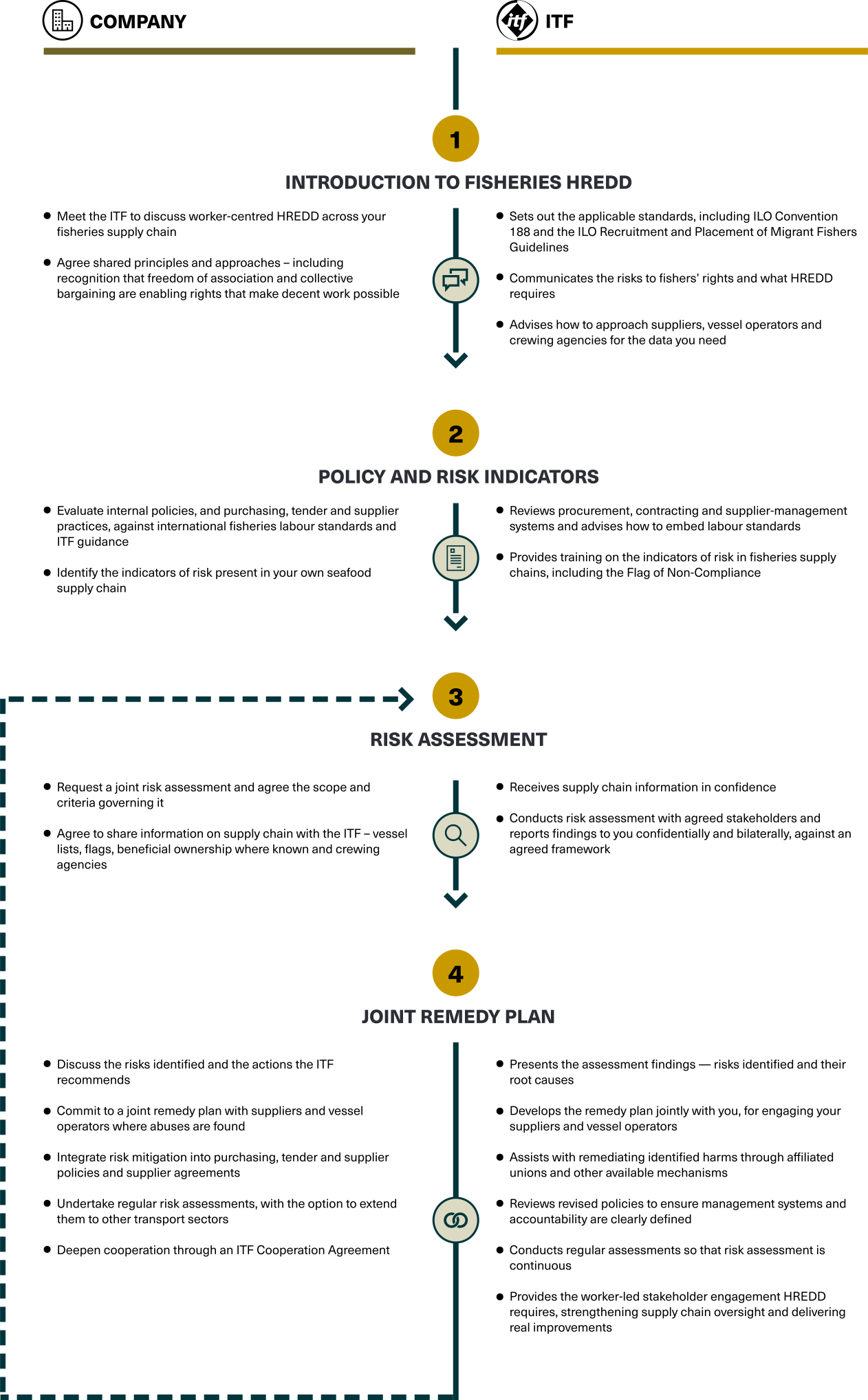
Working with the ITF on HREDD in fisheries follows four stages. It begins with establishing what standards apply and where a company's own commercial terms create risk, moves to a joint assessment conducted with the fishers affected, opens a dialogue on the root causes those findings expose, and ends with a joint remedy plan and continuous monitoring, so the process does not stop at a single snapshot.