

WHY IT MATTERS?
Failing to manage human rights and labour risks exposes companies to legal liability, operational disruption, financial loss and reputational harm. Human Rights and Environmental Due Diligence (HREDD) is the accepted international best practice for managing human rights risks in supply chain – and is increasingly required through regional and national-level legislation.
As a global trade union federation, this guidance deals most extensively with the human rights and labour elements of HREDD. That is not a statement that the environmental side matters less, the two are inseparable.
Internationally recognised human rights necessarily entail environmental aspects, such as the right to a safe and healthy working environment. The OECD Tripartite Declaration of Principles concerning Multinational Enterprises and Social Policy (MNE Declaration) sets out corporate responsibilities on just transition directly, in its chapters on employment and industrial relations, and sets out employer responsibilities for occupational safety and health in the climate context. The UNGPs in turn, rest on core human rights treaties that have been interpreted in line with international environmental and climate law.
Due Diligence Process and Supporting Measures [ image goes here]
Contained in Figure 1 of the OECD Due Diligence Guidance for Responsible Business Conduct 2018
Meaningful stakeholder engagement is fundamental to HREDD: it enables context-specific risk identification, appropriate measures to address risks and effective monitoring. Done right, it improves working conditions and builds supply chain resilience.

TO BE EFFECTIVE AND TO MITIGATE
HUMAN RIGHTS AND
LABOUR RISKS BEING OVERLOOKED,
STAKEHOLDER ENGAGEMENT
MUST BE WORKER-LED AND GENDER-RESPONSIVE.
Transport is uniquely mobile and highly transnational. Therefore, the risks posed, and levels of stakeholder engagement required, are equally unique. To be effective and to prevent or mitigate human rights and labour risks being overlooked, stakeholder engagement must be worker-led and gender-responsive – actively addressing how company operations differently affect people of various genders. Through our global network of affiliated trade unions, the ITF is a unique and key stakeholder in the transport sector and can support the buyers and suppliers of transport services, as well as governments and regulators, to strengthen supply chain oversight, reduce legal, financial and reputational risk – and deliver real improvements in working conditions.
This guidance is grounded in internationally recognised HREDD frameworks that clearly state that effective HREDD depends on respecting freedom of association, collective bargaining and worker engagement. They include the UN Guiding Principles on Business and Human Rights (UNGPs), the ILO Tripartite Declaration concerning Multinational Enterprises and Social Policy, all ten ILO Core Conventions, the OECD Guidelines for Multinational Enterprises and the Ethical Trading Initiative’s Base Code. Relevant corporate accountability legislation is also referenced including the European Union (EU) Corporate Sustainability Due Diligence Directive (CSDDD) which currently list eight ILO Core Conventions; and C155 and C187 on a Safe and Healthy Working Environment will be added once all EU Member States ratify them.
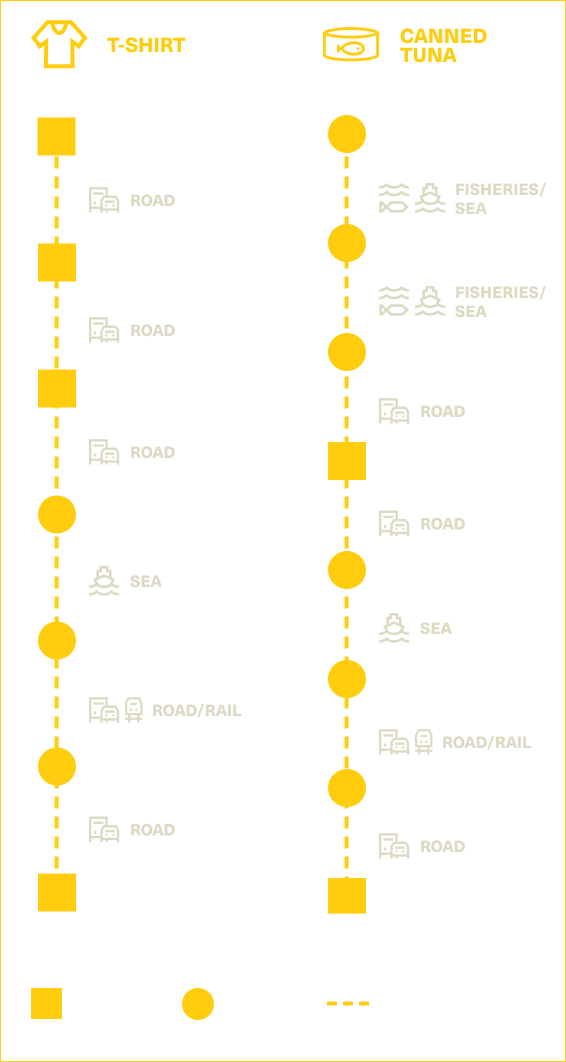
Transport buyers and suppliers are accountable for addressing human and labour rights, and environmental harm, not only in their own operations, but across all third-party relationships. In transport, that means responsibility for the conditions, safety and rights of every worker involved in moving goods and passengers – whether directly employed, subcontracted or engaged through any intermediary.
The ILO defines a lead company as the company that controls the global supply chain and sets the parameters with which other firms in the chain must comply, and which is typically responsible for the final sale of the product. Lead companies in supply chains must recognise how their procurement practices – sometimes known as purchasing practices, the commercial actions, methods, and decisions a company uses to procure goods, materials, or services from suppliers – cascade down a supply chain. For example, in road transport, tightened delivery schedules and cost pressures leading to pressures on drivers which generate a range of human rights risks, spanning fatigue, occupational safety and health and other human rights risks.
A safe, fair and sustainable supply chain is built on decent work, transparency and accountability. At a minimum, it must uphold:
- Internationally recognised human rights
- International labour standards
- ILO codes of practice, guidelines and guidance
- Compliance with agreed industrial and sectoral standards for transport
These rights must be guaranteed for all workers regardless of employment status.
Effective HREDD depends on information only workers hold about the day-to-day reality of transport work and the risks that workers in the industry face. Transport workers and their families depend on wages they cannot afford to lose, and can regularly find themselves in highly isolated, and in dependent situations under the direct control of their managers or employers. In this context, audits fail where HREDD can succeed: it is difficult for workers to trust external auditors and speak out about potential harms in their workplaces. The risk is considered too high for most and, as a result, harms remain hidden.
HREDD requires companies to engage with their stakeholders meaningfully at all stages of the process, including workers and their representative trade unions, in order to fully understand the situation and risks workers may face. As outlined in the ETI Framework, identifying actual and potential risks, undertaking mitigating and preventative action, providing remediation and strengthening policies and management systems can only be done effectively through genuine engagement with stakeholders.
This fundamental requirement is recognised both in international guidance and in legislation such as the EU CSDDD. But stakeholder engagement is only ‘meaningful’ if it accounts for the power imbalances and threat of repression that transport workers experience.
Stakeholder engagement must be based on trust, be fit for purpose in solving problems and focused on a human rights-based approach. Co-ownership and sensitivity to context are paramount rather than a top-down approach.
Workers speak to their trade union when they will not speak to an auditor, which means a company working with unions sees the risks in its supply chain directly – not after an incident, an investigation or a headline. A collective agreement negotiated between representative trade unions and employers then turns what workers report into enforceable standards.
As mandatory HREDD regimes expand, companies that embed structured social dialogue and collective bargaining are better placed to meet legal requirements and demonstrate effective risk management – avoiding financial loss, and legal and reputational harm.
Companies sometimes treat transport as a service they buy rather than a part of their supply chain. The EU Corporate Sustainability Due Diligence Directive (CSDDD) does not.
CSDDD Article 5 requires Member States to ensure that companies conduct risk-based HREDD across their own operations, their subsidiaries and – “where related to their chains of activities” – those of their business partners. Due to transport’s inclusion in the “chain of activities” definition, transport or logistics partners carrying out distribution, transport or storage for or on behalf of an in-scope company fall within the HREDD process outlined in Articles 7 – 12.
Article 3(1)(g) of Directive (EU) 2024/1760 defines “chain of activities”. Transport appears in both ‘upstream’ and ‘downstream’ elements, confirming it as being covered by core due diligence duties.
Article 3(1)(g)(i): “… activities of a company's upstream business partners related to the production of goods or the provision of services by that company, including the design, extraction, sourcing, manufacture, transport, storage and supply of raw materials, products or parts of products and the development of the product or the service.”
Article 3(1)(g)(ii): “…activities of a company's downstream business partners related to the distribution, transport and storage of a product of that company, where the business partners carry out those activities for the company or on behalf of the company, and excluding the distribution, transport and storage of a product that is subject to export controls under Regulation (EU) 2021/821 or to the export controls relating to weapons, munitions or war materials, once the export of the product is authorised.”
Under long-recognised international HREDD frameworks – and increasingly, national level HREDD laws – companies are obliged to identify, prevent, mitigate and account for actual and potential human rights and environmental impacts across their operations and value chains.
Human rights and labour risks are highly context-specific, so effective HREDD requires meaningful, two-way stakeholder engagement at every stage of the process. The ITF, representing over 16.6 million transport workers through more than 760 affiliated trade unions in over 150 countries, is a crucial partner in the transport sector and is ready to support companies at each step of the HREDD process.