

The six steps below follow the OECD due diligence framework. At each one, the ITF can offer support and welcomes companies getting in touch to find out more about how to work with us on HREDD.
The ITF holds existing HREDD agreements with companies including ASOS, TFG London and New Look.
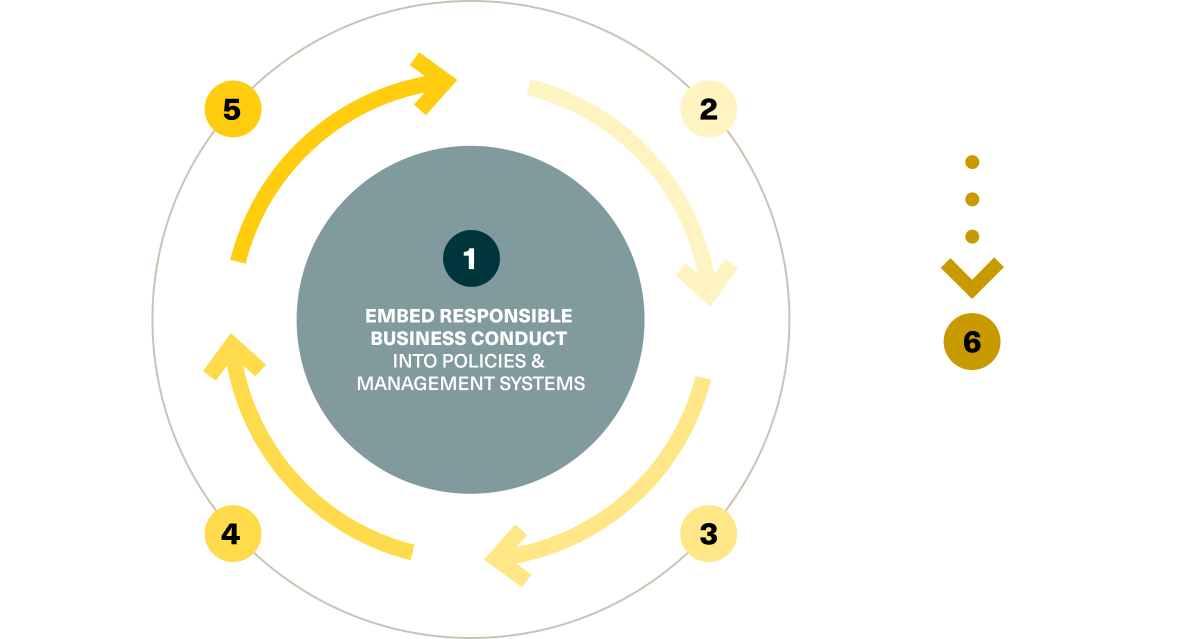
Companies need to have a policy commitment in place which is approved at board level, informed by relevant internal and external expertise, that stipulates human rights expectations, publicly available and reflected in operational policies across the entire business enterprise.
All supply chain actors have a responsibility to guarantee additional standards for specific groups disproportionately impacted by adverse human rights impacts, including women, children, migrants, minorities and persons with disabilities.
The ITF can help develop, implement and evaluate transport-sector policies tailored to a company’s operating context. This includes identifying and closing gaps to ensure that all elements of management systems are defined within policies – or, for example, enhancing procurement, tendering and supplier policies in road transport to incentivise suppliers to respect international standards in road freight and long-distance passenger transport.
The risk mapping across transport on this site provides an introduction to the range of risks, and what causes them, with more specific risk mapping for maritime, fisheries, road transport and warehousing. As HREDD is inherently context-specific, direct engagement with the ITF enables more effective mapping using agreed frameworks and criteria, with bilateral reporting of findings.
Labour impact assessments are an additional, time-limited monitoring method, used alongside ongoing worker-centred HREDD. The ITF has significant experience in conducting ILO-accredited labour impact assessments – including on gendered impacts – and can deliver them at a depth commensurate with the level of risk facing specific groups of transport workers.
Support the ITF can provide could also include:
- Advice on how to approach transport suppliers to obtain necessary information, such as vessel lists, flag and ownership details, subcontracting and haulier tiers, terminal and warehouse sites, employment status and agency arrangements, and collective bargaining coverage across their transport supply chain.
- Training on how to spot risk indicators in road transport supply chains.
- Developing the qualitative and quantitative scope of risk criteria.
- Gender impact assessments and gender-responsive HREDD.
- Arranging joint training with ITF affiliates to support risk assessments.
- In maritime shipping specifically, the ITF can combine company logistics data with the ITF RightsCheck system – harnessing the ITF’s unique international agreement and inspection data – to generate a risk assessment of labour standards on ships moving goods.
Transport trade unions have unmatched access to and understanding of the often-opaque realities of supply chains – they see first-hand how company and supply chain actor decisions affect workers within them. Because transport is so heavily subcontracted, the root causes of risks are often invisible from the top of the supply chain – meaning that prevention of risks can fail. Companies and supply chain actors must work with the ITF to assess and address risks at their source.
Collective bargaining is the most effective and efficient means of cooperation with trade unions to cease, prevent or mitigate risks. Respect for freedom of association requires companies and other supply chain actors to exercise neutrality and not obstruct trade union recognition: they must take measures to create an enabling environment for constructive industrial relations in their operations and their transport supply chains. In practice, this means providing ITF-affiliated trade unions with physical access to their sites and workers, and conducting joint activities like trainings.
The ITF can help support:
- Building and facilitating stakeholder relationships along the transport and logistics segments of value chains to mitigate potential risks.
- Strengthening of procurement practises, and tender and supplier policies, to identify, prevent and mitigate risks.
- Moderating and facilitating dialogue on tackling root causes of identified risks.
- Developing prevention plans to engage transport suppliers on risks.
Monitoring within worker-centred HREDD is unique: trusted, peer-to-peer information networks enhance monitoring processes and provide unrivalled workplace access and information. The ITF’s worker-centred HREDD models enable companies buying transport services to properly address impacts on human and labour rights in their transport supply chain.
Subsequently, companies, their suppliers and other supply chain actors must ensure transparency and share information commensurate with the complexity of the operations and supply chains being monitored, including data and information on workplace representation and collective bargaining coverage.
The ITF can:
- Provide verified ITF Inspectorate data – sourced from ship inspections carried out by the ITF’s global ship inspector network – to track implementation in maritime shipping – focused on real rights impacts, far exceeding anything available via audits.
- Support in the design of the most appropriate data-tracking indicators.
- Assist the remedy of harms through local and global mechanisms, including ITF affiliates and the ITF Inspectorate, among others.
Credible communication rests on credible evidence: the ITF’s transport data and direct access to workers can facilitate both. Meaningful and trustworthy data and workers’ own voices should be central to communicating how effective HREDD is undertaken and works in practice.
Remedy for actual harms suffered must be context-specific and can take on multiple forms, from apologies to restitution, rehabilitation, financial and non-financial compensation, and guarantees of non-repetition. Whatever the form, remedy should restore affected people or communities to the situation they would have been in had the harm not occurred – including by financial or non-financial compensation. Above all, for remedy to be effective, it must be based on engagement and dialogue: consultation with affected people is essential.
The ITF can:
- Provide access to remedy of harms through local and global mechanisms that enable dialogue with workers.
- Act as an operational-level grievance mechanism to find and resolve issues earlier – in line with workers’ needs – thereby lowering legal risks