The ITF played a leading role in securing the now 20-year-old Maritime Labour Convention – and it continues to advocate for its implementation and updating to protect seafarers’ rights
Before 2006, the global protection of seafarers’ rights rested on a patchwork of more than 60 maritime labour conventions and ‘recommendations’: few were ratified, some overlapped, and many were outdated by the rapid changes taking place in the global shipping industry.
From the perspective of protecting seafarers’ rights, these gaps were not simply legislative loopholes – their cost could be counted in the human and labour rights abuses faced by the workers who play a central role in keeping the world and its trading relationships moving forward.
In a uniquely international industry, the aim of bringing disparate, unenforced rules into a unified, global treaty – the Maritime Labour Convention 2006 (MLC) – was no mean feat. And it was one that required cooperation and coherence from seafarers’ trade unions, governments and ship owners.
The result of this landmark effort is one of the most significant global labour treaties ever created: a convention with ‘teeth’ that offers a unique level of enforcement, with ratifying states able to detain vessels regardless of the flag they fly, and one that has fundamentally altered the working conditions of seafarers everywhere – and which, crucially, continues to be improved and enhanced through concerted advocacy on behalf of seafarers.
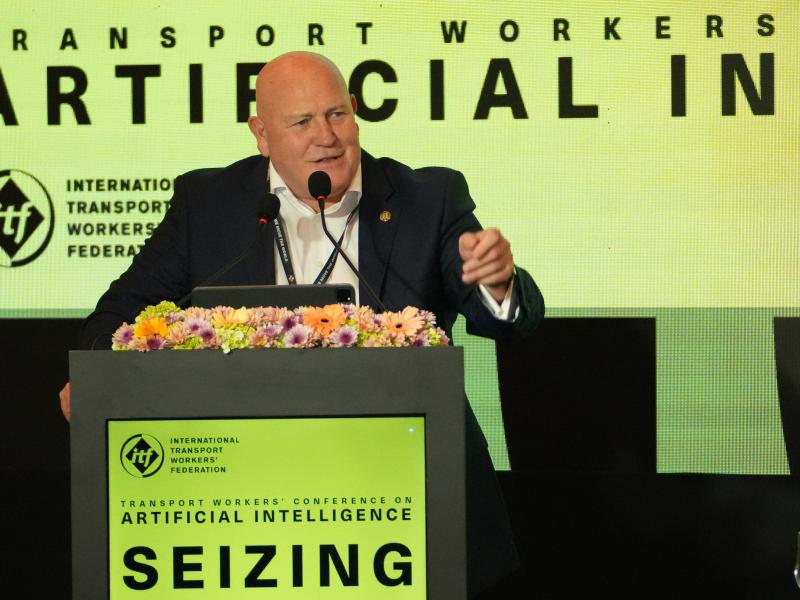
“The significance of the Maritime Labour Convention simply cannot be overstated – it is without doubt one of the world’s most important international labour treaties,” said ITF General Secretary, Stephen Cotton.
“The concerted advocacy that took place to bring the MLC into being is one of the most important international efforts made by the ITF in its long and storied history – one that also demonstrates social dialogue at its best, with trade unions working alongside business and governments to produce genuinely enforceable, global rules to protect workers.
“But as global shipping continues to evolve, so too does the ITF’s mission to protect seafarers and, in turn, the need for the MLC to continuously improve.”
The ITF was at the forefront of the efforts to bring the MLC into being – alongside the International Chamber of Shipping, representing ship owners, and the United Nations International Labour Organization (ILO). To this day, the ITF and its affiliated maritime trade unions continue to work closely with these partners.
Today, the ITF Seafarers’ Trust, an independent UK charity supported by the investment income of the ITF International Assistance, Welfare and Protection Fund, also announced that it is awarding EUR500,000 (USD 587,213) of funding to the ILO to support institutional capacity building to enhance protection of seafarers’ rights in the Middle East.
Former Nautilus UK General Secretary and ITF Seafarers’ Section Chair, Brian Orrell, played a leading role in the ITF’s efforts to secure the MLC.
“While the objective of creating a unique single maritime instrument to replace all those existing at the time was ambitious, the work of the ITF with shipowners and governments was instrumental in securing unanimous adoption twenty years ago,” he explained.
“That the MLC 2006 remains as relevant and important today as it was twenty years ago rests with the foresight of the ITF in securing an agreement – a first within any ILO instrument – on a rapid amendment procedure enabling the instrument to be more easily reviewed and updated. Looking back over the past twenty years, the importance of these procedures in ensuring that the rights of seafarers were delivered has been demonstrated time and again.”
The ability to amend the MLC has proved pivotal. Regularly referred to as a ‘bill of rights’ for seafarers, it sets a floor or minimum level for international standards on seafarers’ labour rights. Amendments made after the MLC came into force in 2013 – via the same formula of tripartite negotiations – include the coverage of vital issues for seafarers such as abandonment, violence and harassment, protecting victims of piracy and, most recently, the 2025 classification of seafarers as ‘key workers’, among others.
“It’s crucial to remember that the MLC is a ‘living instrument’ which must be continuously improved,” said Mark Dickinson, Nautilus International General Secretary, ITF Seafarers’ Section Second Vice Chair, and Seafarer Vice-Chairperson at the Special Tripartite Committee of the MLC.
“Just as the maritime industry continues to evolve and new threats to seafarers’ rights and working conditions emerge, so too must we come together to ensure the MLC adapts to ensure that seafarers are protected at all times, in all their areas of work.
“After 20 years of the MLC, it’s important that we look back and reflect on a landmark achievement – but it’s even more important that this legacy is reflected in our ongoing work to ensure the MLC continues to protect every seafarer, everywhere.”
ENDS