Geneva – The 113th Session of the International Labour Conference (ILC) opens today in Geneva, bringing together governments, employers and workers’ delegates from all 187 ILO Member States to negotiate new international labour standards on decent work in the platform economy and protection against biological hazards in the workplace. The ILC will also see a critical general discussion on pathways from informal to formal employment and hearings in the Committee on the Application of Standards.
The International Transport Workers’ Federation (ITF) has arrived with a high-level delegation of union leaders from around the globe, determined to secure a Convention and Recommendation that guarantee enforceable rights for all digital platform workers, including the millions who keep transport moving on these platforms.
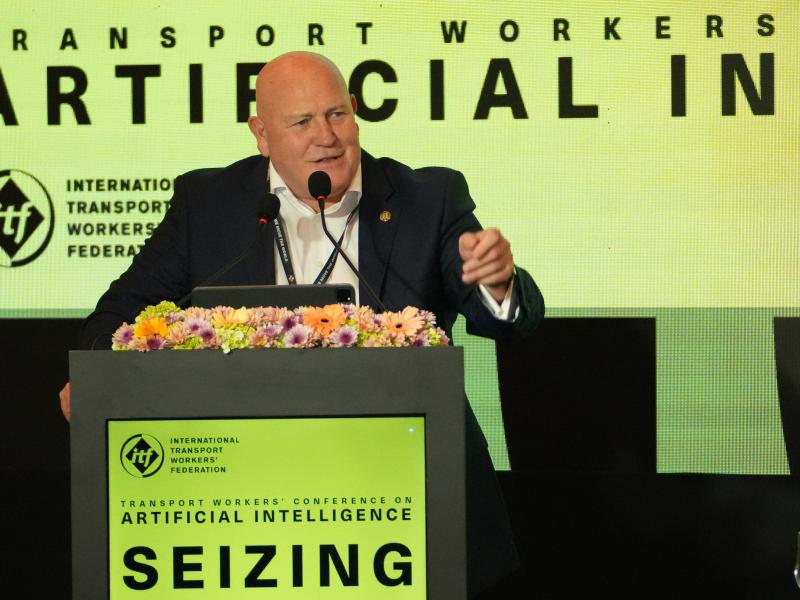
“Today we celebrate putting decent work for platform workers firmly on the ILO agenda,” said Stephen Cotton, ITF General Secretary. “For over a decade the ITF has exposed exploitation in the platform economy, campaigned for legislative reform, negotiated with gig companies, and today we see platform workers’ rights reflected in the ILC’s programme. This is a once-in-a-generation opportunity to build a global floor of rights for a rapidly expanding, yet inadequately regulated sector.”
But the next phase of work starts now. Transport platform workers have spelled out exactly what must change, and the ITF delegation in Geneva stands shoulder-to-shoulder with them to make governments deliver.”
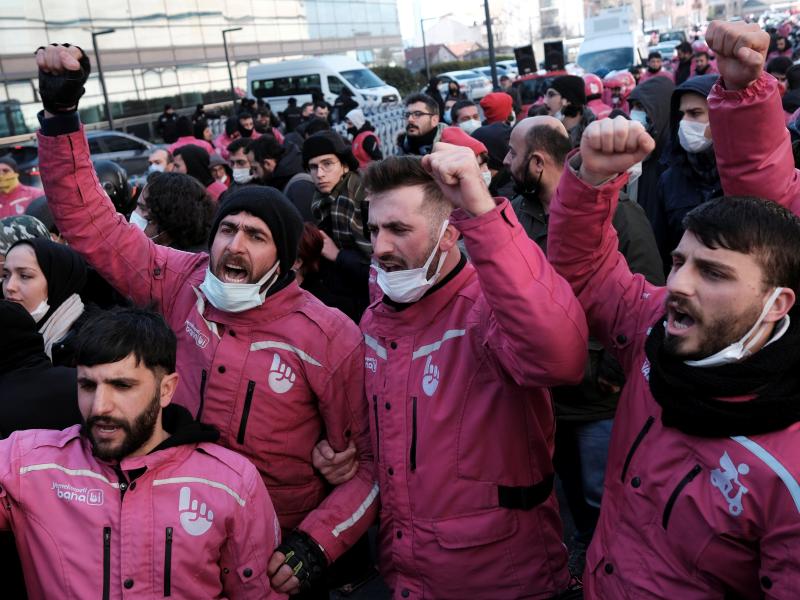
The ITF’s foremost objective will be to secure a binding Convention, supplemented by a Recommendation, that reflects the 11 demands of transport platform workers. These instruments must ensure that all platform workers are entitled to full labour rights and protections and not be left to suffer from the scourge of misclassification.
Eleven demands of transport platform workers
- Guarantee legal protection for all platform workers
- Cover every form of platform work – in-person or online
- End misclassification of workers as ‘independent contractors’
- Guarantee basic workplace rights: unionise, safe conditions, freedom from violence
- Regulate algorithmic management so it is transparent and bargainable
- Guarantee a living wage that includes paid waiting time
- Ensure universal social protection – health, sick leave, pensions
- Give workers control over their data – access, portability, protection
- Stop unfair deactivations – require reasons, human review, appeal
- Provide clear, written contracts with stable terms
- Enforce the rules – inspections, access to justice, dispute resolution
The ITF calls on governments and employers to join workers in to ensuring that these new instruments reflect the lived realities of workers in the digital economy and close the regulatory gaps that have facilitated exploitation and undermined decent work.
Protecting workers from biological hazards in the workplace
The Standard-Setting Committee on Biological Hazards sat for the first time at the ILC last year, where the Workers’ Group insisted on a tripartite agreement that negotiations would result in a binding Convention and a supplementary Recommendation.
In the Committee’s first draft, workers won agreement that:
- the new standards must protect all workers, everywhere;
- the impact of climate change on biological hazards is recognised—for the first time in an OSH Convention;
- a precautionary and preparedness-based approach is adopted;
- health is understood broadly, including mental health and wellbeing; and
- a gender-responsive perspective is integrated, alongside many other protective provisions.
The regulatory gap on biological hazards in the workplace was on the ILO agenda even before the COVID-19 pandemic. The ITF fought then for transport workers’ right to a safe working environment as they kept passenger transport and global supply chains moving, often at great personal risk.
“This Convention must reach far beyond infectious diseases and pandemic situations,” said Cotton. “Since occupational safety and health has been recognised as an ILO fundamental principle and right at work, there is no alternative but to secure broad, comprehensive protections against all biological hazards that workers face daily. This is our fight this year.”
Throughout the Conference, the ITF delegation will also meet ministers, employer representatives and ILO officials to press forward transport workers demands including the imposition of Article 33 measures against Myanmar for persistent non-observance of Conventions Nos 87 and 29, recognition of the Palestine as a non-member observer State, and the adoption of the latest amendments to the Maritime Labour Convention.
The delegation will stand in global solidarity with the wider labour movement: joining the ITUC and sister Global Union Federations to launch the ITUC Global Rights Index 2025 – the definitive scorecard of workers’ rights abuses internationally – and taking part in solidarity events for Palestine, Myanmar, Belarus and Ukraine.