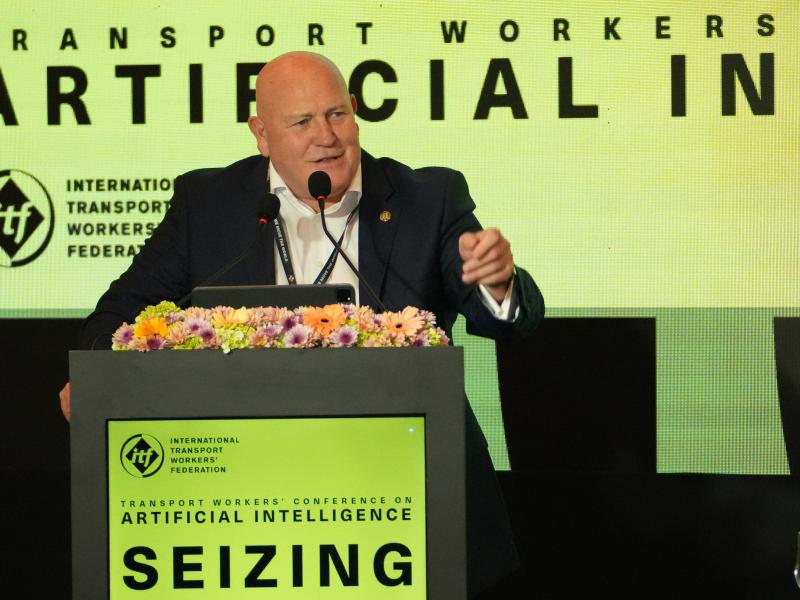
Copenhagen. The ITF, the International Transport Workers Federation, welcomes the opportunity to speak to Maersk executives and shareholders today. We represent more than 700 affiliated trade unions from 153 countries and nearly 20 million workers across the world. The ITF brings together unions in the struggle to secure rights, equality and justice through improving the working lives of our members.
At ITF’s Congress in 2006, our affiliates resolved to form the ITF Maersk Network in recognition of the fact that your company, directly or indirectly, employs thousands of ITF transport workers. We are proud that in April 2016, Maersk and the ITF Network formed an agreement to ensure any vessel Maersk charters has an ITF or similar agreement covering it, which puts in place protections for crews on flag of convenience ships.
Since then, our relationship has grown to further solve disputes and issues faced by Maersk workers at Maersk Line, APM Terminals, Svitzer, and other Maersk maritime subsidiaries. We look forward to expanding our collaboration with your company to ensure our affiliates’ rights to collective bargaining and freedom of association are secured throughout the supply chain from sea to docks, trucking, warehousing and beyond.
We want to start off by remembering those we lost last year: Two Svitzer colleagues died in a ferry incident in Tangier. Another colleague died in Indonesia during a road traffic accident on a journey between port and warehouse. Subcontracted workers, two truck drivers and one crane mechanic, died at work at a terminal belonging to APMT in Los Angeles. Three other fatalities in subcontracted work were reported by your company. We also remember Ian Webb from Liverpool, a Svitzer worker who fell to his death in 2019 due to the company failing to provide a safe system of work despite several internal complaints being raised since 2015.
One worker’s death is one too many – and there were nine in the last year. Maersk should not forget the unequal distribution of fatalities at work - death is not considered a possibility as part of the job for executives. Does your company not believe it should be the same for workers across the supply chain? Around the world, our members are fighting for their lives, and livelihoods.
The business practices of Maersk tug and towage subsidiary, Svitzer, are predatory at best. When Svitzer entered the market in Argentina, it perpetuated a race to the bottom in the industry charging services at 75% less than the normal rate, then subcontracting those same companies at 50% of what was previously charged. As a result of these dumping policies that Svitzer uses, CENTENNIAL and national capital company had to sell its shares, reaching the point of being technically bankrupt, economically and commercially. Workers paid the price through job losses in the industry and a downward spiral in conditions and wages. As a leading global conglomerate, which many companies in the maritime industry valorise, Maersk should not be engaging in such wolfish practices at human cost.
Svitzer Australia, a subsidiary of your leading multinational, attempted a lockout of its workforce in 16 Australian ports, rather than coming to the table and bargaining in good faith after over 4 years of failed negotiations. While Maersk expands into new industries, this cannot be the precedent for Maersk’s treatment of its own employees.Indian contract laborers at AMPT are still waiting to receive the COVID bonus that direct employees received in 2021 despite the ITF Network having raised their situation repeatedly. Maersk subcontractors must be valued by Maersk in the same way as direct employees are.
In the Netherlands, Maersk Line has refused negotiation with office workers, despite 82% of employees wanting a collective agreement concluded with the unions. The company union MPN (MaerskLine Professionals Network) even stopped its role as a union for Maersk Line employees because of management attitude, a clear case of union busting. Star Container Service will notentertain talks on a CBA. These practices are not in line with Maersk’s professed principles on fundamental labour rights.Your company’s latest annual report committed “to respecting fundamental labour rights and constructive employee relations.” Maersk claims to align with core ILO conventions and internationally accepted UN and OECD frameworks and comply with relevant local legislation. Your report says the “organization respects the rights to freedom of association and collective bargaining, supports tradeunion and work council engagement, the rights to not be subjected to forced labour, child labour or discrimination in respect of employment and occupation and standards on working hours and the safety and health of workers”.We simply ask that Maersk live up to its own principles. ITF believes that the sustainability test for global companies is how well they satisfy Environment, Social and good Governance criteria. That’s why we support the proposal from shareholders Akademiker Pension and LD Fonde that the Board of Directors set out more clearly what the Group has done to respect human rights and labour rights and how it will tackle flagged risks.Finally, your company, one of the largest shipping companies in the world, saw profits increase by more than 26 times in a two-year period, earning US$49 billion in profit 2021 and 2022. At the same time, the company’s tax rate fell to just 3 percent in 2022. All the while, in Denmark, an average income worker paid a 39.1% tax rate. This tax rate is thirteen times higher than the tax rate Maerskpaid in 2022. ITF and the Centre for International Corporate Tax Accountability and Research has found that if the Danish Government had levied the company tax rate these years, it would have gained another $9.7 billion in tax.Your company has made super profits during the pandemic and the corresponding supply chain crunch at a low tax rate, while at the same time the company has been putting its workers and suppliers under increasing pressure around the globe.
Thank you