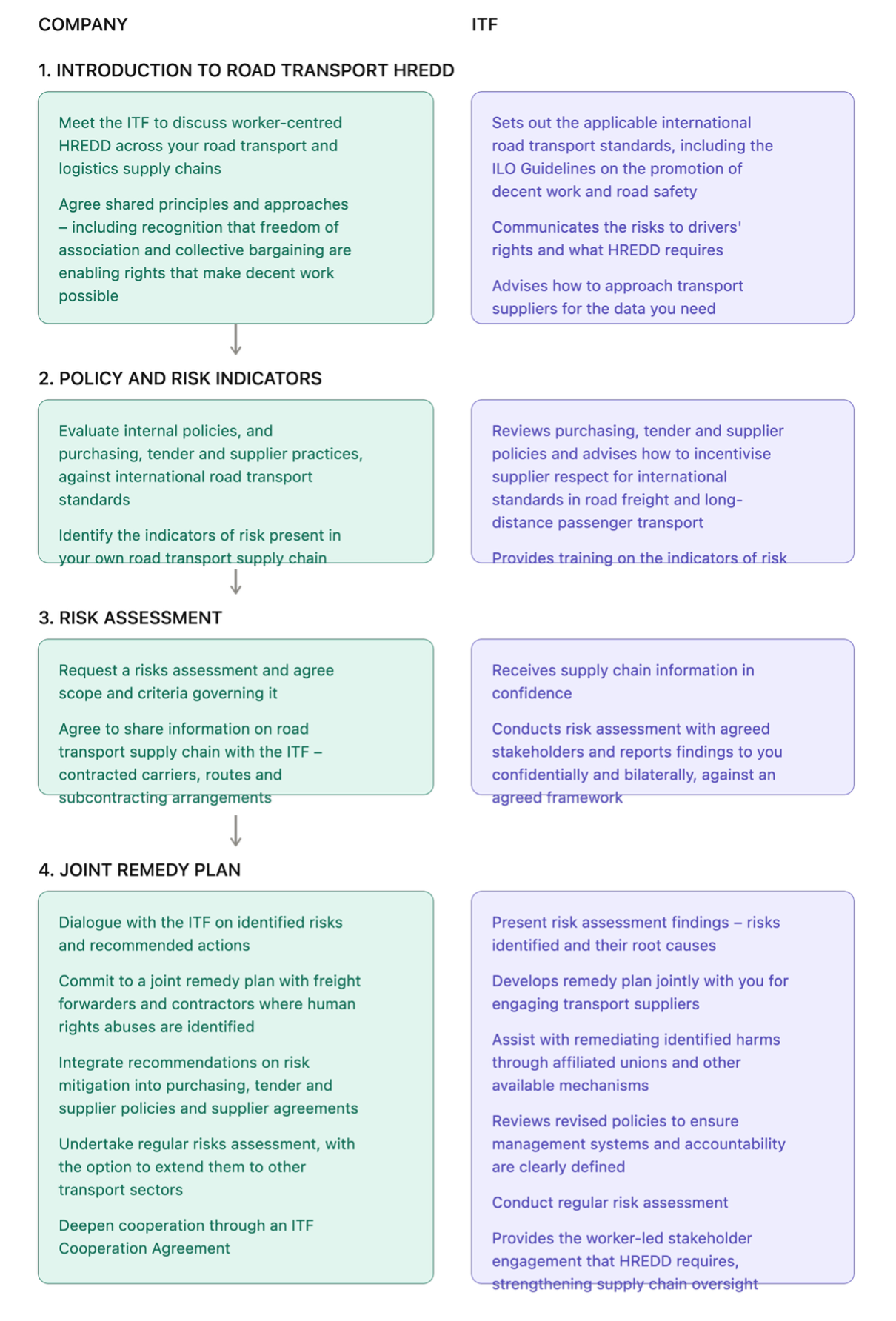
Working with the ITF on HREDD in road transport follows four stages, each building on the last. The process begins with establishing what standards apply and where a company's own commercial terms create risk, moves on to an evidence-based assessment conducted with the workers affected, opens a dialogue on the root causes those findings expose, and ends with a joint remedy plan and continuous monitoring, ensuring the process does not stop at a single snapshot.
1. INTRODUCTION TO ROAD TRANSPORT HREDD
Company
Meet the ITF to discuss worker-centred HREDD across your road transport and logistics supply chains Agree shared principles and approaches – including recognition that freedom of association and collective bargaining are enabling rights that make decent work possible ITF Sets out the applicable international road transport standards, including the ILO Guidelines on the promotion of decent work and road safety in the transport sector Communicates the risks to drivers' rights and what HREDD requires Advises how to approach transport suppliers for the data you need
2. POLICY AND RISK INDICATORS
Company
Evaluate internal policies, and purchasing, tender and supplier practices, against international road transport standards Identify the indicators of risk present in your own road transport supply chain ITF Reviews purchasing, tender and supplier policies and advises how to incentivise supplier respect for international standards in road freight and long-distance passenger transport Provides training on the indicators of risk in road transport supply chains
3. RISK ASSESSMENT
Company
Request a risk assessment and agree on the scope and criteria governing it Agree to share information on road transport supply chain with the ITF on contracted carriers, routes and subcontracting arrangements ITF Receives supply chain information in confidence Conducts risk assessment with agreed stakeholders and reports findings to you confidentially and bilaterally, against an agreed framework
4. JOINT REMEDY PLAN
Company
Dialogue with the ITF on identified risks and recommended actions Develop a joint remedy plan to address identified risks and support company engagement with transport suppliers. Integrate any resulting recommendations on risk mitigation into purchasing, tender and supplier policies and supplier agreements Undertake regular risks assessments, with the option to extend them to other transport sectors Recognise commitment to ongoing stakeholder engagement with the ITF through an ITF Cooperation Agreement Build stakeholder relationships along the value chain to mitigate risk Act on remedy with the support of independent and reputable partners
ITF
Present risk assessment findings highlighting the risks identified and their root causes Develop a joint remedy plan to address identified risks and support company engagement with transport suppliers Assist with remediating identified harms through affiliated unions and other available mechanisms
Reviews revised policies to ensure management systems, procurement practices and accountability are clearly defined Provide training on the indicators of risk in road transport supply chains Conduct regular risk assessments continuously Facilitate the development of stakeholder relationships along the value chain to mitigate risks
Provides the worker-led stakeholder engagement that HREDD requires, strengthening supply chain oversight and delivering real improvements
[ABOVE TEXT COULD BE PRESENTED LIKE BELOW]