The International Transport Workers’ Federation (ITF), together with Nautilus NL and FNV, has submitted a formal request to the Court of Appeal in the Netherlands to reconsider and correct key preliminary considerations in its recent interim ruling concerning the Non-Seafarers’ Work Clause (NSWC).
The NSWC is a long-standing provision designed to protect seafarers’ rights, safety, and wellbeing, and forms an integral part of ITF collective bargaining agreements.
ITF believes these preliminary considerations – although not forming the Court’s final judgment – must be clarified to ensure the fundamental right to collective bargaining is fully upheld and to strengthen the role of social dialogue across the European Union.
In its submission, the ITF argues that the Court’s interim judgment makes a number of incorrect suggestions and assumptions. The ITF and its affiliates argue that:
- The NSWC does not violate the principle of free competition within the EU, the clause exists within a freely negotiated collective agreement.
- ITF cannot be considered an ‘undertaking’ as meant in EU competition law, on the basis that it is a trade union federation and does not provide “services” to employers.
- The NSWC does not constitute an unjustifiable breach to the freedom to provide services within the EU, established EU case law protects collective action and the autonomy of social partners.
Although the Court of Appeal has not ruled on the validity of the NSWC itself and is awaiting guidance from the Court of Justice of the European Union (CJEU), the ITF maintains that these preliminary considerations are contrary to well-established EU case law and risk undermining workers’ fundamental rights as well as the European model of social partnership.
The ITF has formally requested that the Court reconsider these preliminary considerations and rephrase the preliminary questions it intends to send to the CJEU, ensuring they accurately reflect both the purpose of the NSWC and the legal principles governing collective bargaining.
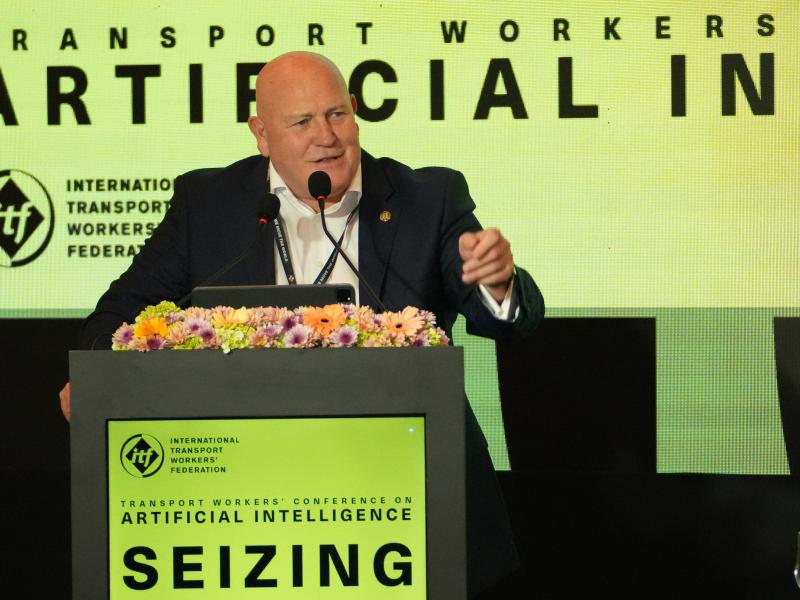
“The right to organise and to bargain collectively is at the core of the European social model,” said Stephen Cotton, ITF General Secretary. “We will use every legal avenue necessary to ensure that seafarers’ rights are upheld and that social dialogue remains a cornerstone of EU democracy.”
Livia Spera, General Secretary of the European Transport Workers’ Federation (ETF) said:
“When a court questions well-established principles of collective bargaining, even in one sector, it risks weakening it everywhere. Europe’s transport systems rely on skilled, organised workers, and those workers rely on strong collective agreements. We expect the Dutch Court to uphold the European model of social dialogue, not to undermine it.”
Should the Court decline to make these corrections, the ITF has also requested approval to lodge an interim appeal with the Dutch Supreme Court.
Given the far-reaching implications of the interim ruling for all unions within the European Union—not just in the maritime sector—the European Trade Union Confederation (ETUC) has also requested permission to intervene in the appeal proceedings.
“Collective bargaining is not a distortion of competition, it is a fundamental right,” said Esther Lynch, General Secretary of the European Trade Union Confederation (ETUC). “We stand with the ITF in insisting that courts across the EU respect and protect the autonomy of social partners. If they fail to do so, the consequences will reach far beyond the maritime sector and strike at the very heart of all workers’ rights in Europe.”
ENDS
Notes to Editors
- Cargo handling and lashing – securing containers to the deck of a vessel, using heavy lashing bars and bottle screws – is dangerous work that should be undertaken by trained dock workers, who work in pairs to mitigate safety risks.
- Forcing seafarers to undertake cargo handling exposes them to danger in the task itself, while also elevating the risk of accidents at sea on vessels made unsafe by badly lashed containers and other cargo. For seafarers, such tasks add to fatigue at the end of voyages when they should be resting or taking shore leave. For dockers, forcing seafarers to undertake cargo handling takes jobs away from qualified workers.
About the ITF: The International Transport Workers’ Federation (ITF) is a democratic, affiliate-led federation of transport workers’ unions recognised as the world’s leading transport authority. We fight passionately to improve working lives, connecting trade unions and workers’ networks from 147 countries to secure rights, equality and justice for their members. We are the voice of 16.5 million transport workers who move the world.
Media contact: Luke Menzies, media@itf.org.uk