The ITF calls for urgent action to protect transport workers, passengers and communities.
The Road Transport Section Steering Committee of the International Transport Workers’ Federation (ITF) stands with road transport workers and all transport workers affected by rising and volatile fuel prices linked to the conflict in the Middle East and other sources of global instability.
The ITF represents more than 16.6 million transport workers across the world, including workers in road, rail, seafaring, ports, aviation, urban transport, fisheries, inland navigation and tourism services. These workers keep people, goods, food, medicines, energy and all essential supplies moving every day. They must not be forced to pay the price for war, instability, speculation or failures in supply chain planning.
Road transport workers are among the most exposed to this crisis. Truck, coach, bus, taxi, app-based and delivery workers are facing higher operating costs, longer delays, growing pressure from clients and employers, and increased risks to their income, safety and health.
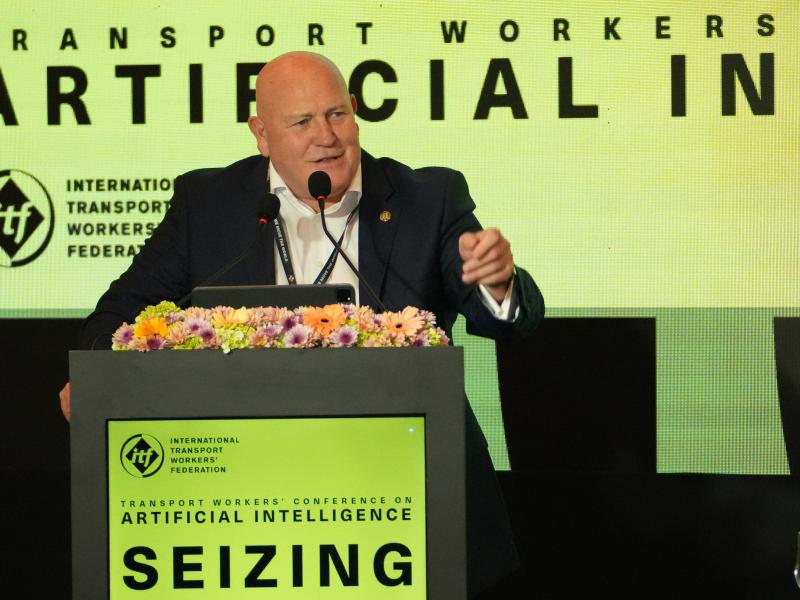
Flemming Overgaard, Chair of the ITF Road Transport Section Steering Committee and President of the Danish transport workers’ union, 3F Transport, said: “No transport worker should be made to carry the cost of this crisis that is not of their making – road transport workers, and all transport workers, must be protected by governments and employers, who must do all they can to work with the trade unions that represent them.
“We all depend on road transport workers to keep our world moving forward by delivering the goods we need and transporting passengers, and they and their communities need and deserve protection, safe work and fair pay.”
For owner-drivers, dependent contractors, informal workers, platform workers and workers in subcontracting chains, fuel increases can immediately wipe out earnings. For employed drivers, fuel shocks are too often used to falsely justify wage restraint, unpaid waiting time, longer hours, unsafe schedules and attacks on decent work. Digital technologies and platforms must never become another mechanism for shifting costs and risks onto workers, intensifying workloads or undermining collective bargaining.
Young transport workers are particularly exposed to the fuel price crisis. Many enter the industry through platform work, subcontracting and non-standard forms of employment where rising fuel costs can almost entirely be borne by workers themselves. A generation that should be building long-term careers in transport instead faces growing higher costs, unstable incomes, job insecurity, and limited opportunities for decent work.
This crisis affects the whole transport system. Seafarers, dockers, aviation workers, railway workers and public transport workers are facing disrupted routes, unstable demand, higher costs and intensified pressure to keep global and local supply chains functioning.
Transport workers did not create this crisis – they must not be made to pay the cost.
The current situation exposes a deeper problem: too many transport systems are organised around low-cost contracting, weak accountability and the transfer of risk onto workers. Fuel price increases are not simply a business cost. When employers, clients and governments fail to act, they become a direct threat to wages, working time, road safety, public safety and the right to decent work.
The ITF calls for urgent action to protect road transport workers, passengers and communities.
We demand that employers:
- Cooperate with trade unions to develop measures that reduce the impact of fuel price increases on road transport workers, including owner-drivers, subcontracted workers, dependent contractors, platform workers and informal workers.
- Introduce fuel-cost adjustment mechanisms so that rising costs are passed through supply chains to the companies and clients with the power to pay, not imposed on drivers.
- Protect wages, allowances and paid working time, including waiting time, delays, diversions, refuelling time and border or port congestion.
- Stop using fuel costs as an excuse for wage restraint, job cuts, bogus self-employment, unpaid work or attacks on collective bargaining.
- Renegotiate delivery schedules and contracts to reflect real operating conditions, and that ensure drivers are never pressured to speed, skip breaks, overload vehicles or work excessive hours.
We demand that governments:
- Introduce targeted financial protections for transport workers, including emergency income protection and fuel support that reaches workers directly.
- Regulate contracting chains, require fair cost pass-through, enforce minimum wages, working-time rules, social security and employment rights, and attach strong labour conditions to any public support for transport companies.
- Protect public transport services, prevent profiteering, guarantee safe routes and secure parking, and involve trade unions in all crisis-response planning.
- Develop long-term transport resilience strategies with trade unions that integrate workforce planning, technological change, energy transition, and crisis preparedness, ensuring workers are protected throughout the transition.
Transport workers keep the world moving in times of crisis. They deserve protection, bargaining power, safe work, fair pay and a transport system that puts workers and communities before profit.
ENDS
Media Contact: Mark Dearn | media@itf.org.uk | +44 7850 207412
About the ITF: The International Transport Workers’ Federation (ITF) is a democratic, affiliate-led federation recognised as the world’s leading transport authority. We fight passionately to improve workers’ lives, connecting more than 760 affiliated trade unions from over 150 countries to secure rights, equality and justice for workers’ globally. We are the voice for more than 16.6 million transport workers across the world.