Today, the International Labour Conference (ILC) adopted the Convention concerning Decent Work in the Platform Economy – the first binding international labour standard for the platform economy. For millions of platform transport workers around the world, the rules of the game have now changed.
After more than eight years of campaigning by the International Transport Workers' Federation (ITF), our affiliates and the wider labour movement, the International Labour Organization has delivered a Convention that recognises what platform workers have known for years: platforms do not simply connect work – they shape, organise and govern it.
The vote at the 114th ILC completes the process begun at the 2025 Conference, when constituents made the historic decision to pursue a binding global labour standard.
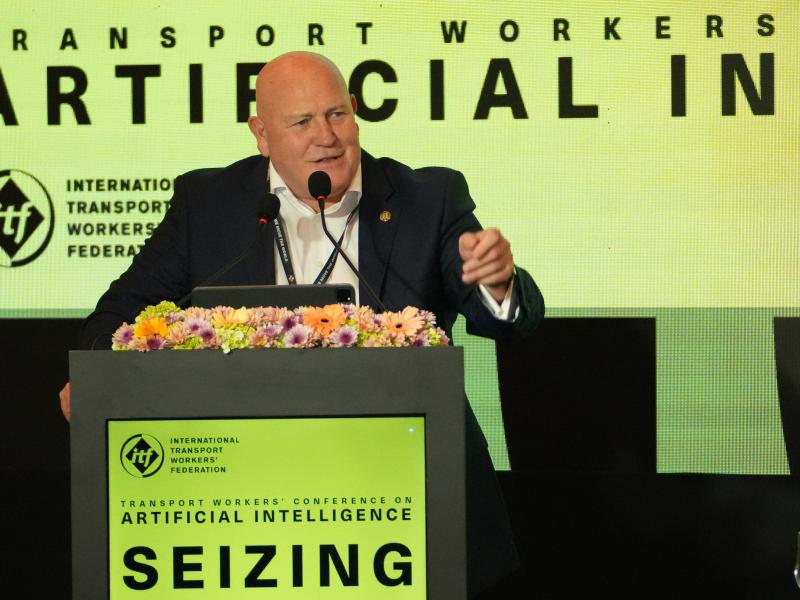
"This is a victory won by platform workers themselves – the delivery riders, ride-hail drivers and app-based transport workers who organised, testified and refused to accept that an app could strip them of their rights," said Stephen Cotton, ITF General Secretary. "Labour standards have adapted to every major transformation of work over the last century. Today, the world has ensured they adapt again."
Rights that don't depend on a label
One of the Convention's most significant wins is that protections are no longer treated as exclusive to traditional employment relationships. It applies to all digital labour platforms and all digital platform workers, defined as persons employed or engaged for remuneration or payment, regardless of their employment classification.
In doing so, it enshrines a simple international principle: workers should not have to choose between access to work and access to rights.
Workers can no longer automatically lose protections simply because a platform labels them self-employed. Core protections extend to platform workers, including:
- Fundamental principles and rights at work, including the rights to organise and bargain collectively.
- Occupational safety and health, including the right to remove themselves from dangerous situations.
- Protection from violence and harassment.
- Data protection and privacy rights, including the right to access, correct and erase personal data.
- A right to receive a written explanation of automated decisions that adversely impact on working arrangements and access to work.
- A review with human involvement of automated decisions concerning the suspension or deactivation of worker accounts.
- Fair pay and cost recovery.
- Protection from unlawful suspension and deactivation.
- Access to dispute resolution and remedies.
Crucially, governments must also ensure platform workers are correctly classified – guided by the facts of how work is performed and paid, not the label a company chooses to apply. This is a direct answer to the misclassification trap that has shut millions of workers out of their rights. Combating employment status misclassification in the platform economy based on the primacy of facts principle is now a codified international standard.
Algorithms held to account
For the first time in an ILO Convention, algorithmic management is addressed directly.
Platforms must inform workers and their representatives about automated monitoring and decision-making, explain how these systems affect working conditions and access to work, provide written explanations and review mechanisms for decisions affecting pay, suspension, deactivation or termination, and ensure appropriate human involvement.
For transport workers managed by apps, ratings and automated systems, the principle is now international law: digital management does not remove responsibility – and no worker should lose access to work because of an unexplained algorithm.
Pay, safety and social protection
The Convention requires payment in full and on time, and compensation for expenses and costs incurred in carrying out work. Crucially and for the first time in an International Labour Convention, it expressly provides that governments consider extending minimum remuneration protections to workers outside an employment relationship.
Safety is recognised as a platform responsibility – not only an ‘employer’ responsibility. Where platforms – whether an employer or not – influence pace, conditions and access to work. Governments must allocate responsibility for keeping workers safe. And the Convention establishes that platform workers cannot simply be excluded from social security systems.
"For too long, platform workers have been forced to choose between access to work and access to rights. This Convention establishes an international principle that no worker should ever have to make that choice," said Cotton.
Now governments must ratify
While the ILC was unable to discuss the draft Recommendation accompanying the Convention due to a lack of time, the ILO’s Governing Body has been instructed to take all appropriate decisions concerning the matter in the future.
“Adoption of the Convention is the beginning, not the end,” Cotton explained. “The ITF thanks the governments that stood firmly with workers. We now call on every government to ratify the Convention without delay and implement it in full, in law and in practice.
“To our affiliated unions: this Convention is a tool, and tools only work when they are used. The ITF will work with affiliates in every region to campaign for ratification, hold platforms to the new standards, and organise the platform workers who made this victory possible.”
ENDS