The International Transport Workers’ Federation (ITF) condemns the continuing attacks on civilian seafarers caught up in escalating war in Iran and the Middle East, warning that the world’s maritime workforce is once again being forced directly into the line of fire.
Following a meeting of the Warlike Operations Area Committee of the International Bargaining Forum (IBF) today, the ITF and the Joint Negotiating Group (JNG) agreed to designate the Strait of Hormuz, Gulf of Oman and the Persian Gulf as a Warlike Operations Area (WOA) due to the heightened threat to crews and vessels operating in the region.
The designation activates enhanced protections and compensation for seafarers serving on vessels covered by IBF agreements in the war zone.
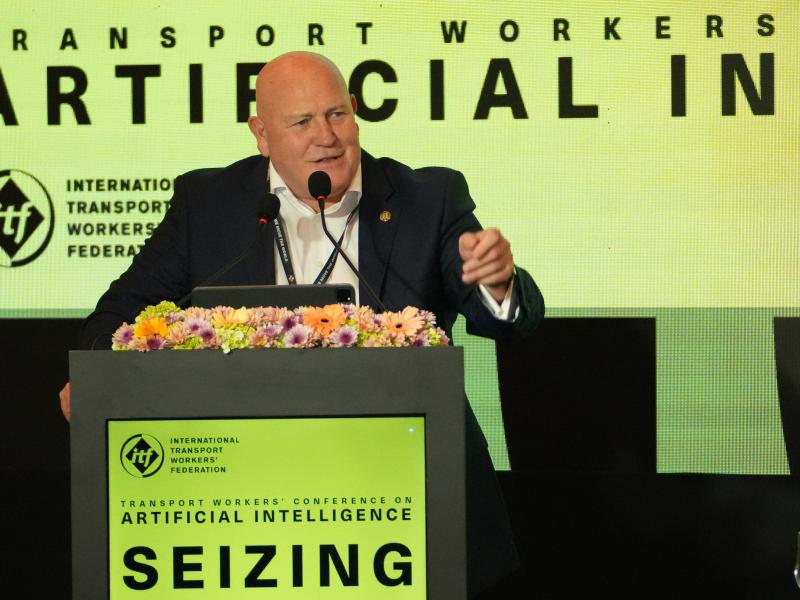
ITF General Secretary Stephen Cotton said the designation reflected the unacceptable reality that civilian seafarers are once again being exposed to.
“Once again, seafarers are being placed directly in harm’s way in a conflict not of their making,” said Cotton. “Too often in recent years we have seen civilian seafarers become the collateral damage of war – whether in the Black Sea, the Red Sea or now in the Strait of Hormuz. These are workers, often from the Global South, far from home and with no connection to the conflicts unfolding around them.
“Today’s designation ensures that seafarers on vessels covered by IBF agreements have critical protections if they operate in this dangerous region. The fact we have to take these measures at all is a damning indictment of the situation facing seafarers today. No worker should have to risk being killed or maimed simply for doing their job – particularly when that job is transporting the oil and goods that keep the world’s economies running.”
Every day since the United States of America and Israel launched ‘Operation Epic Fury’ against Iran on 28 February, ITF Seafarers’ Support has received a high volume of enquiries from seafarers seeking advice and assistance. The most common concerns raised by seafarers include clarification of their rights and protections, specifically around requests for repatriation and questions about their right to refuse to sail into the area.
The situation is compounded by the widespread closure of international airspace across much of the region, which is severely limiting the ability of seafarers to leave vessels and return home. With repatriation routes heavily restricted, many crews face the prospect of remaining on ships operating in an incredibly volatile environment, underscoring the urgent need for de-escalation, stability and the safe movement.
There are already calls to simply reopen shipping routes through the Strait of Hormuz under naval escort. But we must be clear: the safest way to protect seafarers is not to send them through a war zone in the first place,” said Cotton.
“Naval escorts cannot guarantee the safety of civilian crews. No escort can eradicate the risk of missiles or drones striking a merchant vessel and harming civilian seafarers. The priority must be de-escalation, diplomacy and an end to the conflict. Until then, civilian seafarers should not be placed in the line of fire.”
Around 1,000 ocean going vessels are stranded in the Gulf following the halt of vessel movements through the Strait of Hormuz, highlighting the scale of disruption and risk facing seafarers.
David Heindel, Chair of the ITF Seafarers’ Section and International President of the Seafarers’ International Union of North America, said the designation demonstrated the importance of cooperation between unions and shipowners when seafarers’ safety is at risk.
“The actions taken today by the social partners of the International Bargaining Forum show why cooperation between shipowners and operators and seafarers’ unions is essential,” said Heindel. “Through constructive social dialogue, we can respond quickly to emerging risks and ensure that the safety, rights and wellbeing of the world’s mariners remain the first priority. Seafarers are civilian workers, and together we must ensure they are protected from the consequences of geopolitical conflict.”
The ITF stressed that while the WOA designation provides important protections, the only real solution is de-escalation. The designation will remain under regular review by the Warlike Operations Area Committee (WOAC).
ENDS
Media Contact: Mark Dearn | media@itf.org.uk | +44 7850 207412
Notes for Editors
The International Transport Workers’ Federation (ITF) and the Joint Negotiating Group (JNG), as the social partners of the International Bargaining Forum (IBF), today agreed to designate the Strait of Hormuz, Gulf of Oman and Persian Gulf as an Warlike Operations Area (WOA) following a review today by the Warlike Operations Area Committee (WOAC).
Under the terms agreed by the IBF parties, seafarers serving on vessels within or entering the designated WOA will be entitled to the following protections:
- A bonus equal to 100% of basic wage, payable for a minimum of five days, and for each additional day a vessel remains in the area.
- Doubled compensation for death and disability arising from incidents in the area.
- The right for seafarers to refuse to sail into the area, with repatriation at the company’s cost and compensation equal to two months’ basic wage.
- A recommendation for ship operators to implement enhanced security arrangements equivalent to ISPS Level 3.
The Warlike Operations Area designation will remain under regular review by the IBF WOA Committee.
About the ITF: The International Transport Workers’ Federation (ITF) is a democratic, affiliate-led federation recognised as the world’s leading transport authority. We fight passionately to improve workers’ lives, connecting more than 730 affiliated trade unions from over 150 countries to secure rights, equality and justice for workers globally. We are the voice for more than 16.5 million transport workers across the world.
About the JNG: The Joint Negotiating Group (JNG) allows for the coordination of the views of employers from across the world in the maritime industry. The JNG today consists of the International Maritime Employers' Council (IMEC), the International Mariners Management Association of Japan (IMMAJ), the Korean Shipowners Association (KSA) and Taiwan-based company Evergreen.
About the IBF: The International Bargaining Forum (IBF) is the forum that brings together the International Transport Workers' Federation (ITF) and the international maritime employers that make up the Joint Negotiating Group (JNG). IBF negotiations include both central negotiations and local negotiations which allow for development of core principles which can then be incorporated into specific local arrangements. This unique approach to pay negotiations is the only example of international collective bargaining.