Every day, tens of thousands of truck drivers keep East and West Africa moving, hauling food, fuel, medicine and goods across thousands of kilometres. For most drivers, their employment is marred by poverty wages, no contract and a working life that chips away at their health and dignity. But the ITF and our African affiliates are fighting back.
Before a single wheel turns, most long-distance truck drivers in Africa are already at a disadvantage. Widespread subcontracting – often through multiple layers of subcontracting – means that accountability for working conditions effectively disappears. Drivers frequently cannot identify who their legal employer is, let alone enforce rights against them.
Formal employment contracts are the exception. Social protection including health, unemployment and disability insurance is largely absent, particularly for those working for smaller operators and informal contractors.
"What we are seeing across the region is a system deliberately designed to obscure responsibility," says Flemming Overgaard, Chair of the ITF Road Transport Section. "Drivers are treated as disposable at the end of a very long supply chain. The multinationals at the top set the commercial terms that make decent pay and safe conditions impossible – and then point elsewhere when things go wrong."
Mohammed Dauda Safiyanu, ITF Africa Regional Secretary, is direct about the human cost: "When a driver is injured, when he can't work, when something goes wrong on the road, they have nothing. No safety net, no employer that takes any responsibility. The system has been allowed to function this way for too long, and workers are paying the price with their livelihoods and their lives."
Exhausted, exposed and under pressure
The pressure on drivers to keep moving and to make up time lost at borders, weighbridges and checkpoints is relentless.
Regulations on driving hours and mandatory rest periods exist in most countries. Enforcement is another matter. Chronic fatigue and sleep disorders are among the most serious occupational risks drivers face, and border delays that can stretch to days make it worse.
"A driver sits for 36, 48 hours waiting to cross," says Safiyanu. "They lose income. Then the pressure is on them to make that time back on the road, driving faster and sleeping less. They pay with their health, and sometimes with their life."
The lack of adequate roadside infrastructure makes an already precarious job even more challenging. Across transport corridors, secure parking, rest facilities, and basic sanitation are often limited or entirely unavailable. Drivers are forced to sleep in their vehicles or by the roadside, with little protection from theft or violence. Without designated, safe places to stop, rest periods become irregular and unsafe, or impossible, which exacerbates fatigue and leaves drivers exposed to further risk.
The fuel crisis currently gripping much of Africa, and the rest of the world, has compounded everything. Skyrocketing prices and supply shortages trap drivers in extended delays, squeeze already-thin earnings, and force them to absorb operational losses that were never theirs to bear.
Poor road conditions, ageing and poorly maintained vehicle fleets, and endemic violence, xenophobia and cargo theft along the corridors add further layers of risk. The recent terrorist attacks on Malian drivers brought the security threat into sharp international focus, but violence is a daily reality across multiple routes.
Weak training standards, limited occupational safety systems and poor professional certification undermine the standing of truck driving as an occupation. Women and young people remain significantly underrepresented, deterred by safety concerns, the absence of gender-sensitive facilities, and long periods away from home.
"Our members are not just fighting for better pay," says Overgaard. "They are fighting to come home alive," says Overgaard. "We need a road transport sector that people want to enter and can build a career in. Right now, we are asking women and young people to join a profession that offers them insecurity and danger, not an attractive career. That is not sustainable."
Confronting accountability at the top of the supply chain
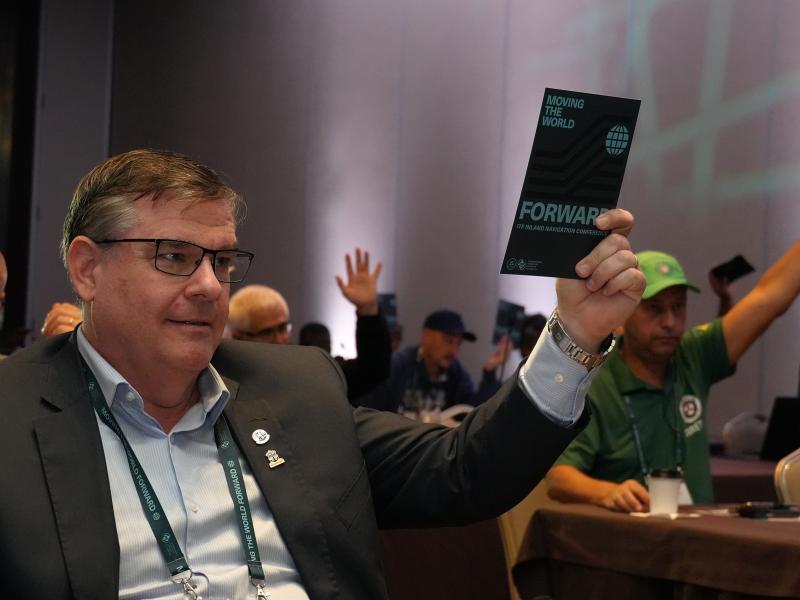
In May 2026, Overgaard travelled to Abidjan and Nairobi leading an ITF engage with national authorities, International Labour Organization (ILO) representatives, and global transport and logistics companies. While in Côte d'Ivoire, the delegation also met with the Minister of Transport and Maritime Affairs. The mission was attended by the ITF Head of Road Transport, Inga-Lena Heinisch; the ITF Africa Regional Secretary, Mohammed Dauda Safiyanu; the ITF Africa Deputy Regional Secretary and their regional teams. Meetings were also held with the leadership of the ITF-affiliated road transport and dockers unions in Abidjan as well as the ITF-affiliated road transport unions in Nairobi to strengthen coordination and advance shared priorities across the region.
The mission was part of a broader ITF strategy targeting those who hold the real power in the supply chain – the multinationals, major brands and transport buyers whose pricing decisions make decent work impossible for drivers thousands of miles away.
The ITF's position is clear: when global transport buyers drive prices so low that safety margins and fair wages become impossible, responsibility does not rest with the small local operator alone. The mission pushed this accountability agenda directly challenging companies to answer for conditions in their supply chains and working with the ILO and national authorities to strengthen the regulatory frameworks that protect drivers on the ground.
"We will not accept a model where a global brand profits from supply chains built on driver exploitation and then claims no knowledge of what happens three layers down," said Overgaard.
This work sits within more than two decades of the ITF organising across Africa's road transport corridors, building cross-border solidarity, strengthening union capacity and using the ILO Road Transport Guidelines to push for formalisation of a sector where too many drivers remain without contracts, social protection or a voice.
The ITF Safe Rates Campaign is the forefront of that long-term effort, translating grassroots organising in the sector into direct pressure on those at the top.
As the ITF Safe Rates Action Week (29 June – 6 July) approaches, this year's campaign turns its focus to drivers' mental health including the psychological toll of chronic insecurity, exhausting hours, relentless economic pressure, and an accelerating fuel crisis that is trapping drivers in extended delays and squeezing earnings to breaking point.
"ITF young workers are raising the alarm," said Safiyanu. "They are telling us the next generation of drivers is already experiencing severe mental health pressures before they've properly started their careers. That tells you everything about the state of this sector."
“The ITF Safe Rates Action Week is a moment for every road transport affiliate to mobilise,” said Overgaard. “Unions are urged to take action in their workplaces and countries in support of the ITF's Safe Rates demands: fair pay for all time worked, safe rates systems that cover all workers regardless of employment status, strengthened transparency and contracts, active enforcement of violations, and full trade union rights throughout the supply chain. These are not aspirations, they are the minimum standard drivers are owed.”
The ITF Safe Rates Action Week runs 29 June – 6 July 2026. For more information on Safe Rates see our campaign website here