Organising workers in the informal economy is one of the great challenges of trade unionism.
Because they work outside of the formal economy, most informal workers do not have basic labour rights such as annual, or social protections such as insurance. This leaves them with little bargaining power, and at risk of loss of income through workplace injuries.
IDEA – The Independent Democracy of Informal Economy Association – has been representing Cambodia’s informal workforce since it was formed in 2005. IDEA is focused on representing tuk-tuk drivers, motorcycle taxi drivers, street and market vendors, small traders, domestic workers, small restaurant workers, waste collectors and other informal workers.
IDEA President Vorn Pao has been on the frontline of the struggle for the rights of informal workers in Cambodia. He says that the most effective way to organise informal transport workers is to build trust through face-to-face contact.
IDEA does this by, firstly, mapping where workers are, and finding places where workers congregate. Then it seeks to engage workers through interviews to find out the issues that they are most concerned about Follow-up communications ensure that workers get to understand what IDEA is doing for them, and how they can get involved.
Hard work is paying off
The strategy is clearly working, as IDEA is experiencing significant and sustained membership growth. From just 5,000 transport members in 2019, IDEA now represents over 12,000 transport workers, and 24,000 members in total. It’s an impressive achievement.
A recent ITF organising workshop in Phnom Penh highlighted the enthusiasm and determination of IDEA’s growing membership base. Activists at the workshop spoke of a wide range of issues that are affecting their safety, income, and wellbeing. They spoke passionately about the way rising fuel costs, low wages, and reduced customer demand continue to place pressure on workers' livelihoods.
Excessive working hours, lack of overtime compensation, and weak compliance with labour laws are also causes of major concern, while climate-related challenges, including extreme heat and heavy rain, are making work conditions more difficult and unsafe. Workplace safety is another important issue for Cambodian transport workers, with reports of accidents, unsafe conditions, and inadequate employer support following incidents.
Sticker campaign
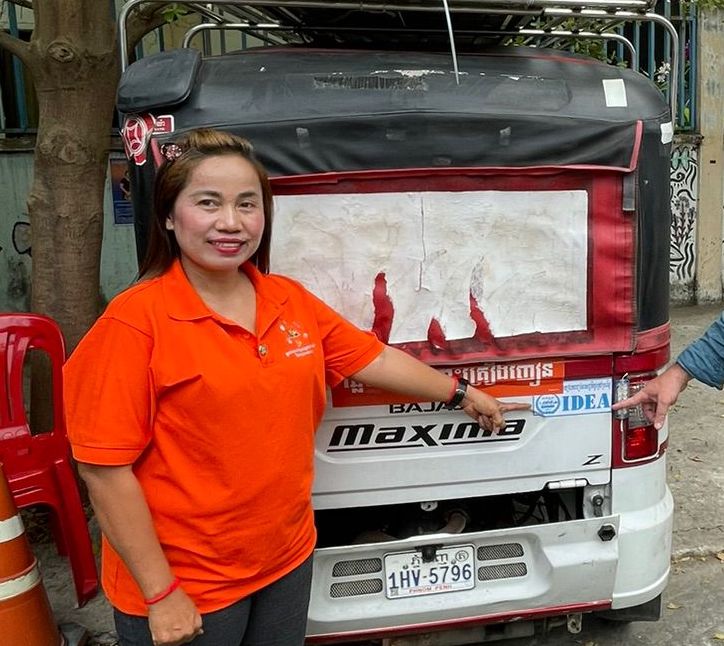
Another visible sign of IDEA’s engagement strategy is the number of IDEA stickers that are springing up on tuk-tuks all over Cambodia. The stickers help passengers to ‘get the IDEA’ by identifying unionised drivers, while also promoting the benefits IDEA membership.
Vorn Pao says the growth of platform-based transport apps like Grab in recent years has presented transport workers with a new set of challenges to overcome. He says greater regional coordination is needed to push back against the platform app operators, and to give platform workers a stronger collective voice.
With the support of the ITF Asia Pacific region, IDEA is continuing to be a powerful and effective advocate for Cambodia’s informal workers.